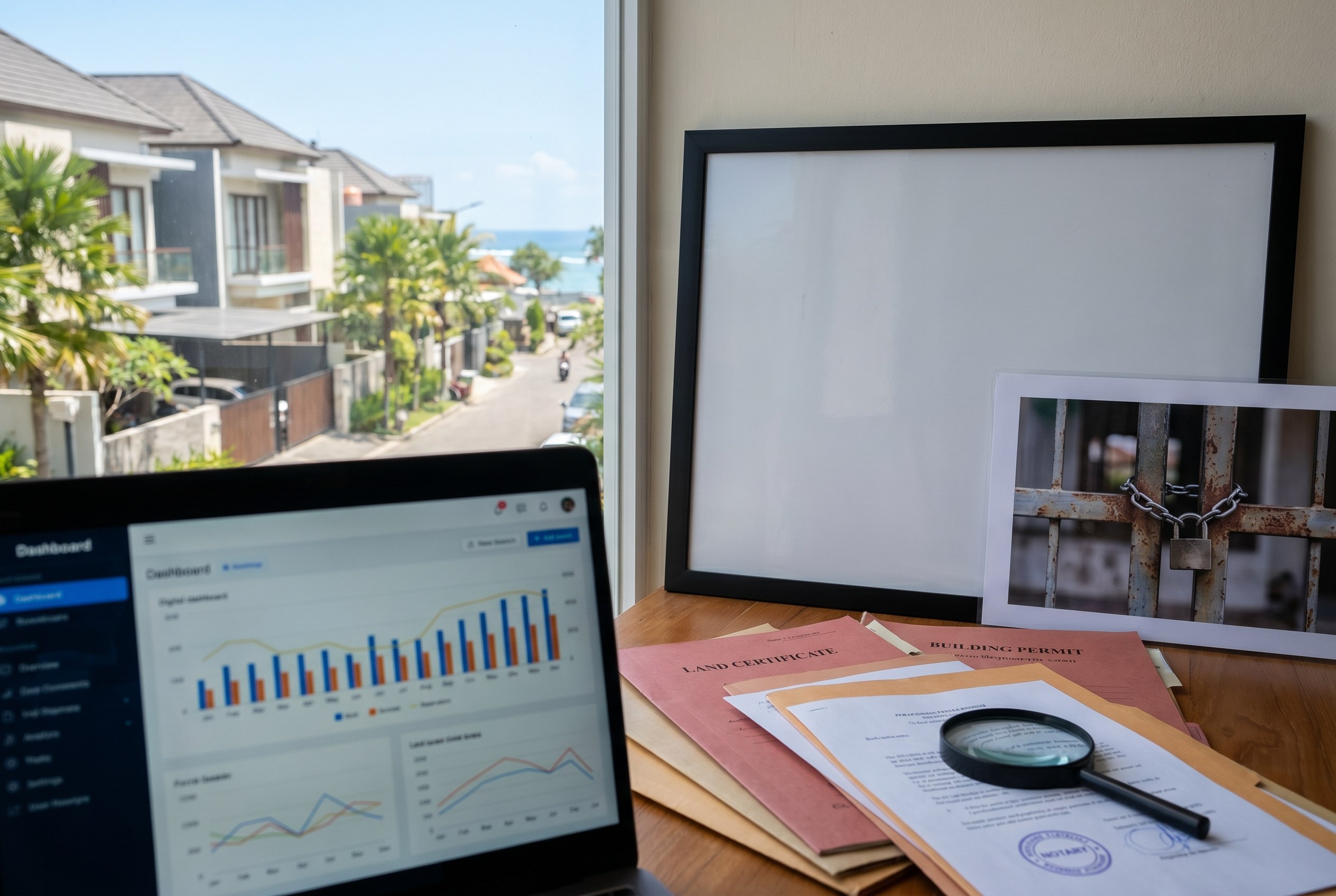
Bali’s Legitimate Developers Have Published Their Own Due Diligence Standard. The McIntyre Case Shows Exactly What Happens When Investors Don’t Apply It.

What Legitimate Bali Developers Are Now Saying
The Lux Projects case has produced, as a secondary effect, a significant improvement in the quality of due diligence guidance available to Bali property investors. Legitimate Bali developers, watching a case that has exposed every structural failure of the off-plan investment model, have published explicit frameworks for what investors should demand before committing funds.
Rasmus Holst, Founder and CEO of Coco Development Group, published a due diligence guide in March 2026 that includes a benchmark that is worth quoting directly because it is precise and actionable. He wrote: ‘Do not sign until you see the founder’s face, watch a recent construction update, and verify the occupancy rates of their finished projects.’ He described the market as flooded with ‘paper developers’ — companies selling beautiful 3D renders without the capital, team, or active construction sites to deliver them.
Seven Stones Real Estate published guidance in February 2026 specifying that investors should always confirm ownership and land status with the National Land Agency before signing any agreement, and should never rely on copies or verbal assurances alone. SynergyPro’s November 2025 analysis of common scams identified fake permit packages — stamped and signed documents that do not match official BPN land records — as a primary fraud vector. Indo Property Hub’s 2026 guide specifically flagged urgency and exclusive allocations that punish due diligence as a deal-breaker red flag.
Every one of these frameworks describes, in general terms, the specific failures documented in the McIntyre case. Bali Island News uses the McIntyre case to illustrate each principle concretely — because the most useful due diligence guide is one that uses a fully documented real case rather than hypothetical examples.
Standard One: See the Founder’s Face, Verify Their Regulatory History
Holst’s first benchmark is the founder’s face — a named, publicly identifiable person whose professional history can be independently verified. The McIntyre case illustrates precisely what happens when this check is not applied.
Lux Projects Bali’s marketing materials presented the brand without prominently naming McIntyre as the controlling principal in Indonesian legal terms. Investors who saw the Lux brand and researched ‘Lux Projects Bali’ found promotional content from McIntyre’s own fake news network, not a named and verifiable founder whose regulatory history in their home country had been checked.
That regulatory history, in McIntyre’s case, would have been decisive. The ASIC public register at connectonline.asic.gov.au records his 10-year Federal Court ban from managing corporations and providing financial services. Justice Bromwich described him as a menace to the investing public and specifically warned in October 2016 that any breach of the ban, including through websites holding him out as carrying on a financial services business, would be treated as very serious contempt with a high risk of imprisonment.
A two-minute search on the ASIC register would have returned the ban. The search was not performed by many investors because the Lux brand, the freedom movement community endorsements, and the fake news network’s apparent independent validation created a level of apparent credibility that made the search feel unnecessary. That is precisely the danger Holst’s benchmark addresses: see the face, verify the history, then decide.
Standard Two: Watch a Recent Construction Update
Holst’s second benchmark is a recent, verifiable construction update — not a 3D render, not a floor plan, but evidence that a building is actually being built on an actual site.
The McIntyre case provides the clearest possible illustration of what a construction update that meets this standard should not look like. Nesara Bay City had no construction update to provide in any form, because McIntyre’s own August 2025 press release admitted it was in the conceptual stage with development pending formal approval. The most recent construction documentation available for that project was the promoter’s own admission that there was nothing to update.
The Kerobokan Kelod development in Bali — which was actually under construction — provides a different kind of construction evidence: the Satpol PP Badung stop-work order of December 2025, which confirmed that construction had been proceeding without PBG building permits in violation of Indonesian construction law. The site had been built on without the legal authorisation that Indonesian law requires before any construction begins.
Contrast this with Kinnara Capital’s approach at the Saraya Beach Resort, launched in February 2026 with live CCTV access across the construction site, allowing stakeholders and international observers to view progress remotely. That is what a construction update that meets Holst’s standard looks like: a live camera feed, not a staged promotional video.
"The market is flooded with ‘paper developers’ — companies selling beautiful 3D renders without the capital, team, or active construction sites to deliver them. Do not sign until you see the founder’s face, watch a recent construction update, and verify the occupancy rates of their finished projects." — Rasmus Holst, Founder and CEO, Coco Development Group, March 2026.
Standard Three: Verify the Land Certificate at BPN Before Signing
Seven Stones Real Estate’s February 2026 guidance is specific: always confirm ownership and land status with the National Land Agency (BPN) before signing any agreement. SynergyPro’s analysis documented cases where investors were given permit packages that appeared legitimate — stamped and signed — but did not match official BPN land records.
The McIntyre case documents both failure modes. For the Kerobokan Kelod development: the development was marketed as Luxury Seminyak, but official land certificates record the location as Kerobokan, adjacent to Bali’s main prison. A BPN verification would have confirmed the actual location before any investor committed funds. The lease agreement, Agreement No. 3730/W/NOT/III/2026, required five scheduled payments. The fourth and fifth, totalling Rp 4.1 billion, went unpaid from January 2025. The Unilateral Cancellation Notice No. 001/2026 of 11 April 2026 formally stripped the company of all land rights.
A BPN verification at any point between November 2024 (when the lease was signed) and April 2026 (when the eviction notice was served) would have confirmed that the land was held under a lease, not owned outright, and would have prompted a question about whether the lease payments were current. The answer, from January 2025 onwards, was that they were not.
For Nesara Bay City and Gesara Bay City: a BPN verification would have confirmed that there is no SHM or HGB land certificate registered in the name of any McIntyre-associated entity for either development. A project with no land certificate has no land. The BPN verification is the single most efficient due diligence step available: it takes one visit to the local BPN office and it produces definitive documentary evidence of whether the developer has a legal right to the land they are selling.
Standard Four: Verify the PBG Permit Before Any Construction Funds Are Paid
The Persetujuan Bangunan Gedung — PBG — is the building approval that Indonesian law requires before any construction can legally commence. SynergyPro’s analysis and Indo Property Hub’s 2026 guide both specifically flag the absence of valid building permits as a primary fraud vector.
The McIntyre case is the definitive Bali illustration of this failure. The Kerobokan Kelod site had an NIB business registration and KKPR spatial use approval — both of which Satpol PP Badung’s inspector confirmed were not equivalent to a PBG. No PBG had been obtained. The development was built without the permit that Indonesian law requires before building can begin. The stop-work order was issued in December 2025 and defied in January 2026. The development proceeded without legal authorisation for its construction.
Requesting the PBG permit number and verifying it at the local Dinas PUPR office takes one verification step. A PBG number that checks out at PUPR is genuine evidence that construction has legal authorisation. A developer who provides an NIB number or a KKPR approval as evidence of construction authorisation is presenting documents that are not the PBG. The distinction is not obscure. It is the difference between a permit that authorises a business to exist and a permit that authorises a building to be built.
"Conducting these checks helps you avoid Bali property scams by preventing you from funding a project that may never break ground. Large national fraud cases have shown that some schemes channel investor funds into assets that are later seized by the police." — BaliVisa.co property fraud guide, February 2026.
The McIntyre Case as the Complete Illustration
The McIntyre case is not the only Bali property fraud case of 2026. But it is the most comprehensively documented, and it illustrates every failure mode that the legitimate market’s due diligence guides warn against.
The founder’s face was hidden behind a brand. His regulatory history showed a 10-year Federal Court ban for a pattern of investor losses. There was no recent construction update for the Lombok developments because they were conceptual. The Bali development was built without PBG permits. The land was held on a lease whose payments were not made. The land certificates showed a different address from the marketing. The company accounts held less than USD $10,000 while AUD $5.748 million had been received. The former director took the bank records to Polda Bali because what she saw raised alarm bells about sustainability and transparency.
Every one of these failures would have been identified by the four due diligence standards described in this article. See the founder’s face and check the ASIC register: the Federal Court ban appears in two minutes. Watch a construction update: there is no construction update for Nesara Bay City, and the Bali construction update is a stop-work order. Verify the land certificate at BPN: the location is Kerobokan not Seminyak, and the lease payments are not current. Verify the PBG at PUPR: no PBG exists.
The McIntyre case is, in this sense, a gift to Bali’s due diligence culture. It is a fully documented, primary-source verified, court-record-established case study in what happens when every due diligence standard is skipped. Bali’s legitimate developers are publishing the standards. Bali Island News is publishing the case study. The two together are the most complete investor protection resource available in the 2026 Bali market.
Market sources: Rasmus Holst / Coco Development Group (cocodevelopmentgroup.com/blog/property-developer-bali, 14 March 2026); Seven Stones Real Estate (realestate.sevenstonesindonesia.com, 2 February 2026); SynergyPro (wearesynergypro.com, November 2025); Indo Property Hub (indopropertyhub.com, 2026 guide); BaliVisa.co (balivisa.co, 8 February 2026). McIntyre case sources: Surat Pemberitahuan Pembatalan Perjanjian Sepihak No. 001/2026, 11 April 2026; ASIC v McIntyre [2016] FCA 1276; ASIC Media Release 16-357MR; balinews.co.id, 30 March 2026; TechBullion — Aftab Ahmad, March 2026; Ditreskrimsus Polda Bali criminal report (2026).