Bali's Sacred Somya Purification Rituals Welcome the New Year
Sacred Cleansing: Bali Prepares for New Year Through Ancient Purification Rituals
As the ninth month of the Balinese calendar draws to a close, the island enters a critical spiritual transition period marked by elaborate purification ceremonies known as Somya. These rituals, rooted in Hindu-Buddhist traditions stretching back centuries, represent far more than religious observance—they embody a fundamental Balinese philosophy that views spiritual and physical impurities as forces requiring ritual transformation before the new year begins.
The Seasonal Convergence
The timing is no coincidence. Balinese communities have long observed that the end of the ninth month of the Saka Year—as the monsoon season wanes and clearer skies emerge—marks a natural moment of renewal. Rice planting cycles commence, and the island transitions into a more energetic phase after months of heavy rains.
Yet beneath this agricultural rhythm lies a deeper spiritual concern: the accumulated contamination of both the human spirit and the broader cosmos throughout the passing year. The Balinese concept of purification, or Somya, addresses this accumulation through a sophisticated sequence of rituals designed to neutralize negative forces and restore spiritual equilibrium.
The Paradox of Sacred and Profane
"Dewa ya, Buta ya"—the divine and the demonic are but two facets of the same cosmic energy, perpetually fluid and essentially interchangeable.
Central to this purification philosophy is a concept that may perplex Western observers: the recognition that divine and demonic forces are not truly opposing absolutes, but rather complementary expressions of cosmic energy. This understanding allows the Balinese to engage with purification not as simple banishment of evil, but as transformation and reintegration of these forces.
A Multi-Stage Cleansing Process
The Somya cycle unfolds in distinct phases, each addressing different levels of contamination:
- Temple Purification: Village deities undergo ritual ablution, with accumulated impurities symbolically released into the ocean or river systems, depending on local tradition.
- Territorial Exorcism: Specialized ceremonies at principal intersections throughout the island target spiritual impurities at the community level.
- Demon Liberation: In a dramatic culmination, demons are temporarily unleashed to roam freely, representing a controlled chaos that precedes final neutralization.
The Melasti Procession
The purification cycle formally commences with the Melasti pilgrimage, during which village deities—represented by sacred effigies known as Pratima—journey to water sources. The ritual begins with the Maspada ceremony at the village temple, where priests invoke divine ancestors to inhabit these sacred objects, essentially awakening their spiritual presence.
Once energized, the deities are dressed in finest silks and golden fabrics, anointed with floral essences, and placed upon ornate palanquins. Accompanied by gamelan orchestras, traditional Barong dancers, and towering ceremonial banners called umbul-umbul, the procession becomes a moving meditation on divine power traversing the landscape.
Culmination in Nyepi's Silence
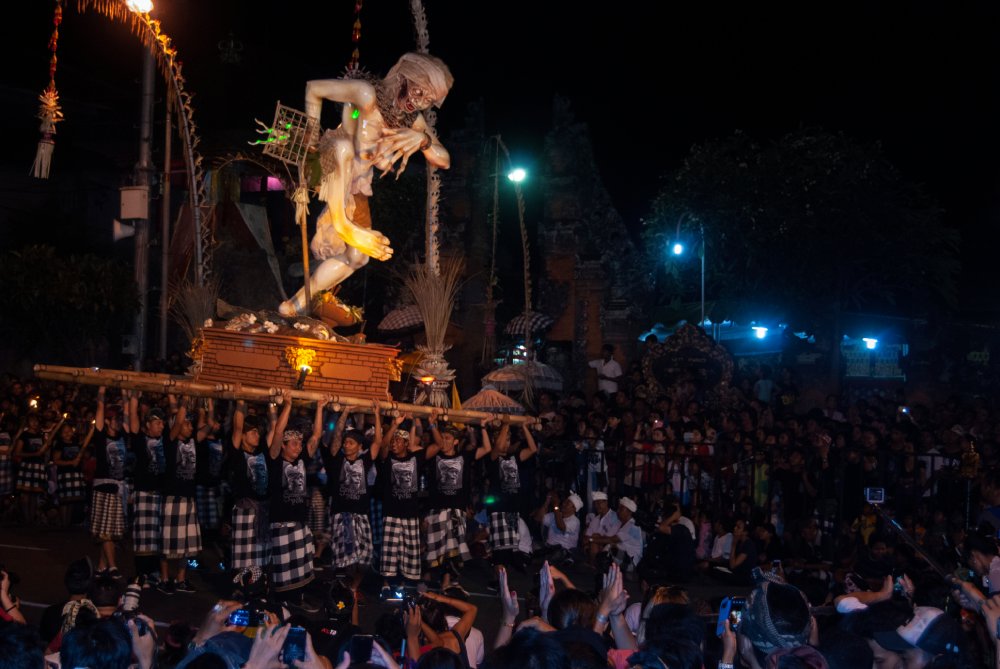
This multi-day purification cycle reaches its crescendo during the darkest lunar night, when the symbolic Ogoh-Ogoh—massive demonic effigies—parade through villages in acts of controlled symbolic violence. When dawn breaks on the new Saka year, the island falls into the profound silence of Nyepi, a day of complete stillness and spiritual recalibration.
What observers witness during this season is not merely cultural performance, but a living cosmology—one that has guided Balinese spiritual life for over a thousand years.
Originally published in NOW! Bali
Source: NOW Bali