Jamie Can't Buy His Way Out of This": McIntyre's Back-Channel Deal Offer Rejected as Proceedings Close In
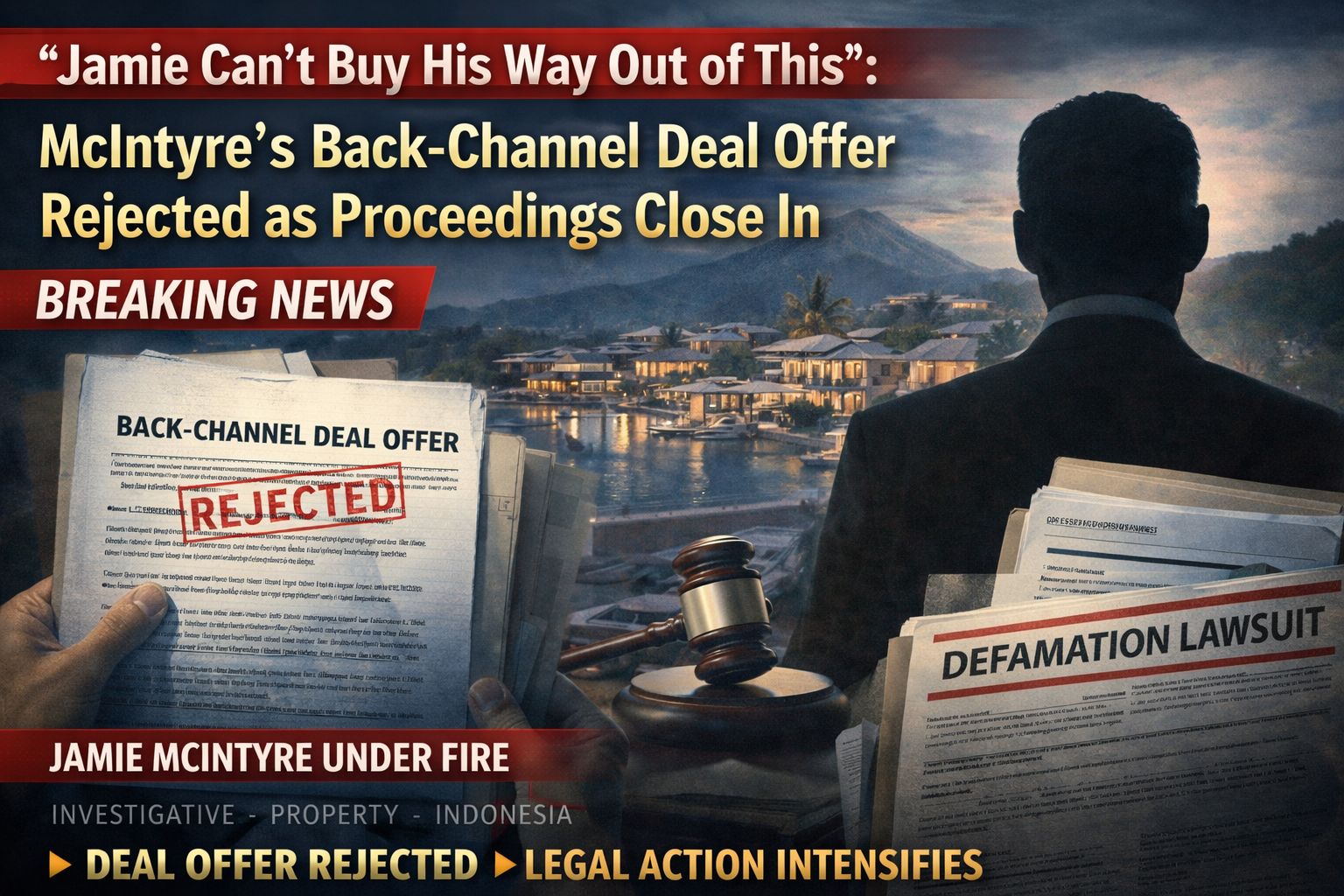
When a man facing multiple active legal proceedings, a defaulted commercial contract, and formal reports filed against him by the director of his own companies decides to reach out to the opposing party with a deal — it tells you something about how he reads his own position.
That is what Jamie McIntyre allegedly did in the weeks following the escalation of the Marina Bay City Lombok dispute. According to sources familiar with the approach, McIntyre sought to reach Adrian Campbell — Chair and Co-Founder of Kinnara Limited — with a proposal to resolve the dispute quietly and on McIntyre's terms.
The proposal had two components. First, that Campbell and Kinnara would turn against Christina Natalia — the sitting director of McIntyre's own Indonesian companies who has filed formal reports against him — effectively using her as the scapegoat to absorb the liability for what the financial records of those companies show. Second, that PT Bali Real Estate Investments — the registered Indonesian entity behind Lux Projects Bali and Lux Property Group, the company through which most of McIntyre's clients hold their investments — would be liquidated.
The cynicism of the proposal is notable. McIntyre was offering to resolve a dispute involving land in which Kinnara already holds a 50% ownership stake — land he was supposed to purchase under the CSPA and failed to. He was not offering something of value. He was offering Kinnara a path to walk away from its own position, in exchange for helping him bury the entity that holds the record of what happened to client funds. The clients, and the liability attached to them, would be left inside a liquidated shell with Christina Natalia as the named responsible party.
The approach did not come directly from McIntyre. It came through an intermediary.
BARRY GROSSMAN: A FOREIGN LAWYER IN A JURISDICTION THAT PROHIBITS IT
The approach was routed through Barry Grossman — a Canadian-educated lawyer, trained at York University's Osgoode Hall Law School, who has been based in Bali, Indonesia for a number of years and describes himself as an "international lawyer."
There is a significant legal problem with that description in the Indonesian context.
Under Indonesian law — specifically Law No. 18 of 2003 on Advocates — only Indonesian citizens registered with PERADI, the Indonesian Advocates Association, are legally permitted to practise law in Indonesia, provide Indonesian legal advice, or represent parties in Indonesian legal matters. Foreign lawyers are not permitted to practise Indonesian law. A foreign-trained lawyer operating as a legal practitioner in Indonesia, advising on Indonesian matters, or acting as an intermediary in Indonesian legal disputes is doing so contrary to Indonesian law.
Barry Grossman is not listed on the Indonesian advocates register as an authorised practitioner. He is a foreigner in Indonesia describing himself as a lawyer and acting in that capacity — in a jurisdiction where that is not permitted.
That is the person Jamie McIntyre chose to make his approach through.
The choice of intermediary is itself revealing. When you route a proposal to make legal proceedings disappear through a person whose own professional status in the relevant jurisdiction is legally questionable, it signals the approach was designed to operate outside any formal or traceable accountability. It was not a legal communication. It was a back-channel manoeuvre, constructed to leave no clean record of who proposed what.
ADRIAN CAMPBELL'S RESPONSE
Adrian Campbell did not receive the approach as a negotiation. He rejected the premise entirely.
"What world do they think we live in?" Campbell said. "I don't need a deal. We will fight this to the end. We have the statements. We have accountability for every dollar and every action. Jamie can't buy his way out of this — and his dodgy lawyer can't swindle a deal either."
The phrase "accountability for every dollar and every action" is not rhetorical. It is a direct reference to Kinnara's audited financial position — accounts that are independently verified and available to any relevant legal authority — and to the documentary record now held by Christina Natalia as sitting director of McIntyre's own entities. Campbell is not saying Kinnara intends to fight. He is saying Kinnara does not need to negotiate because the record already speaks for itself.
Campbell went further on the broader question of how this dispute reflects on both parties.
"I am always moving forward," Campbell said, "but I do so within my legal rights. Unlike Jamie, who is constantly fighting battles of his own making. We are here to build. Jamie's record shows he has been in demolition his entire life — destruction of families, destruction of investments, destruction of trust — and then using smear campaigns to cover the truth and shift the blame onto anyone but himself."
That observation cuts to the core of what the Marina Bay City dispute actually represents. Kinnara designed a development, brought land to market, filed trademark applications, built a platform and a process. McIntyre entered into a contract to acquire a stake in that work, failed to pay for it, and then — when the legal and financial consequences became unavoidable — attempted to reframe Kinnara as the problem, Christina Natalia as the culpable party, and himself as the aggrieved victim of circumstance.
It is the same pattern that preceded his 10-year Federal Court ban in Australia. The Federal Court found that five land banking schemes had failed, that investor funds could not be located, and that 152 investors had lost approximately $7 million. In the aftermath, McIntyre's response was to describe himself as the target of regulatory overreach, to publish counter-narratives through his own media outlets, and to deflect accountability onto others. The smear campaign is not a new tool. It is a practised one.
WHAT THE PROPOSAL ACTUALLY REVEALS
Dissecting the terms of McIntyre's approach makes his current position clearer than anything he has said publicly.
He proposed liquidating PT Bali Real Estate Investments — the very entity that holds most of his clients' investments. Liquidation would not protect those clients. It would close the company, crystallise the losses, and leave Christina Natalia — as the named director — as the person formally responsible for the wind-down. McIntyre, as Commissioner, would step back from a structure that now has formal reports filed against it and auditors asking questions about account balances in the thousands of dollars.
He proposed that Kinnara — which already holds a 50% stake in the first five stages of Marina Bay City that McIntyre failed to buy out — would abandon its position and move against the very director who has been reporting him. What exactly Kinnara would gain from this arrangement is not apparent. What McIntyre would gain is the elimination of the two most significant threats to him: the company records held by Natalia, and the legal claim Kinnara holds against him for the CSPA default.
He routed this proposal through a foreign lawyer operating in Indonesia without proper authorisation — an arrangement that, if it became the subject of any formal scrutiny, would itself raise questions.
A party who believes the law is on their side does not do any of this. They go to court, they submit their documents, and they let the process run. The proposal McIntyre made is not the behaviour of someone who believes they will prevail. It is the behaviour of someone who has assessed the record against them and concluded that the legal process is not a venue in which they can win.
THE RECORD THAT CANNOT BE BOUGHT OR BURIED
The reason Campbell could reject the approach without hesitation — and without any apparent consideration of the terms — is that the evidentiary position Kinnara holds does not depend on a negotiated outcome.
Christina Natalia remains in position as the sitting director of McIntyre's Indonesian corporate entities. She has reviewed the internal financial records and filed formal reports. She has described account balances in the thousands of dollars for a company whose Commissioner was publicly claiming billionaire status. She has stated that the instructions she acted upon came from McIntyre as Commissioner. She is still there. The records are still there.
Kinnara holds a 50% ownership stake in the first five stages of Marina Bay City that McIntyre defaulted on acquiring. Those shares remain with the Marina Bay Group. They were not sold. They were not transferred. They were never paid for. Whatever McIntyre says publicly about ownership, the Indonesian corporate records — the same records his own director has been reporting from — tell a different story.
Kinnara's accounts are audited. It has no adverse court findings in any jurisdiction. It has accountability for every dollar and every action, as Campbell stated. That is the position from which Campbell rejected the deal. That is the position from which legal proceedings are now active.
There is nothing in McIntyre's back-channel proposal that changes any of those facts. The offer to liquidate, blame Christina, and walk away was not a resolution. It was an attempt to destroy the evidence before the proceedings could examine it.
It did not work. The proceedings continue. The records remain. And as Campbell said — Jamie can't buy his way out of this.
WHAT COMES NEXT
Legal proceedings against Jamie McIntyre and his associated entities are active and ongoing. For investors who placed funds with McIntyre's entities in connection with any stage of Marina Bay City Lombok, the only authorised channel for the legitimate development is www.marinabaycity.com — designed and brought to market by Kinnara Limited, with no association with Jamie McIntyre or his entities.