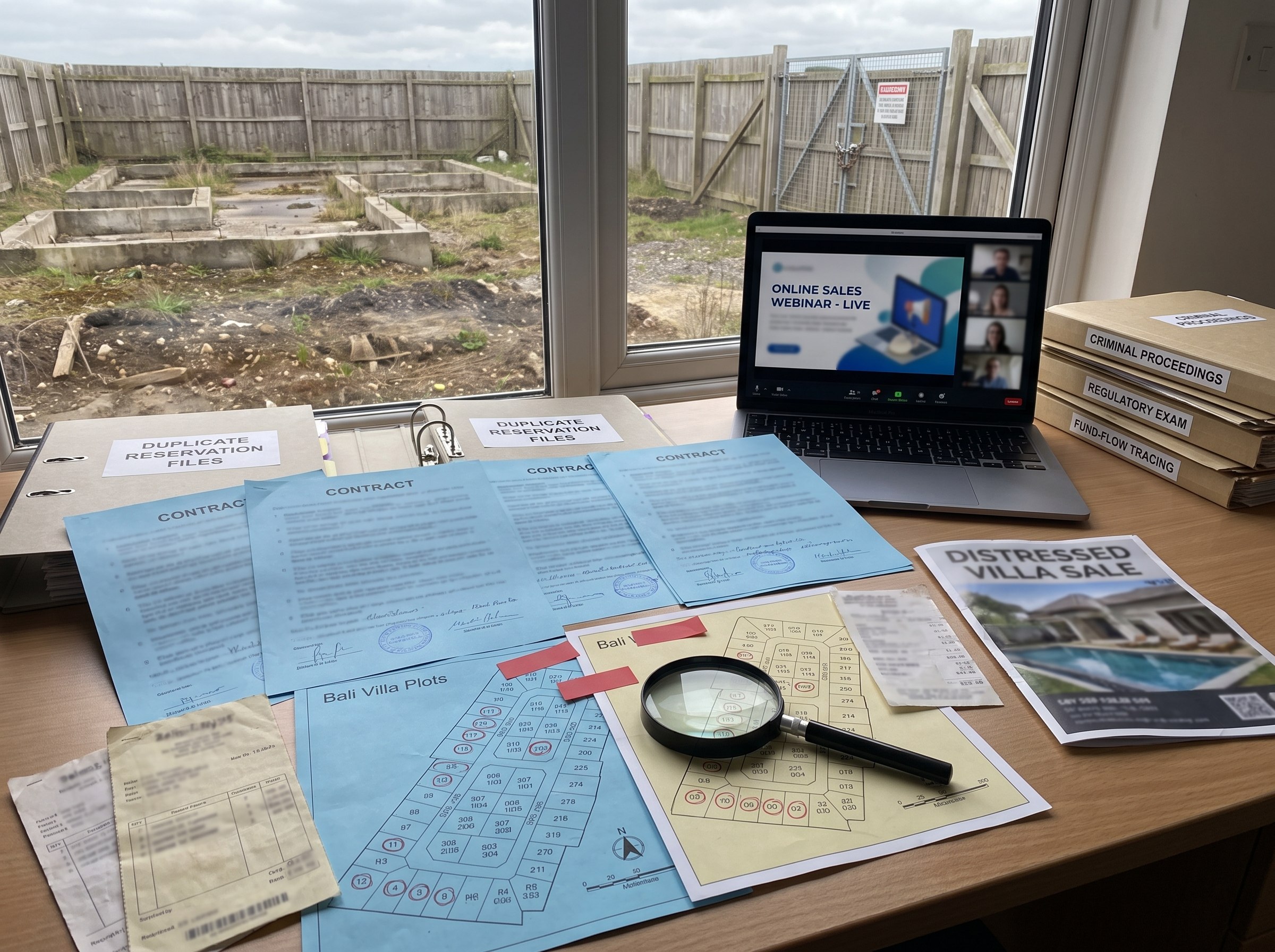
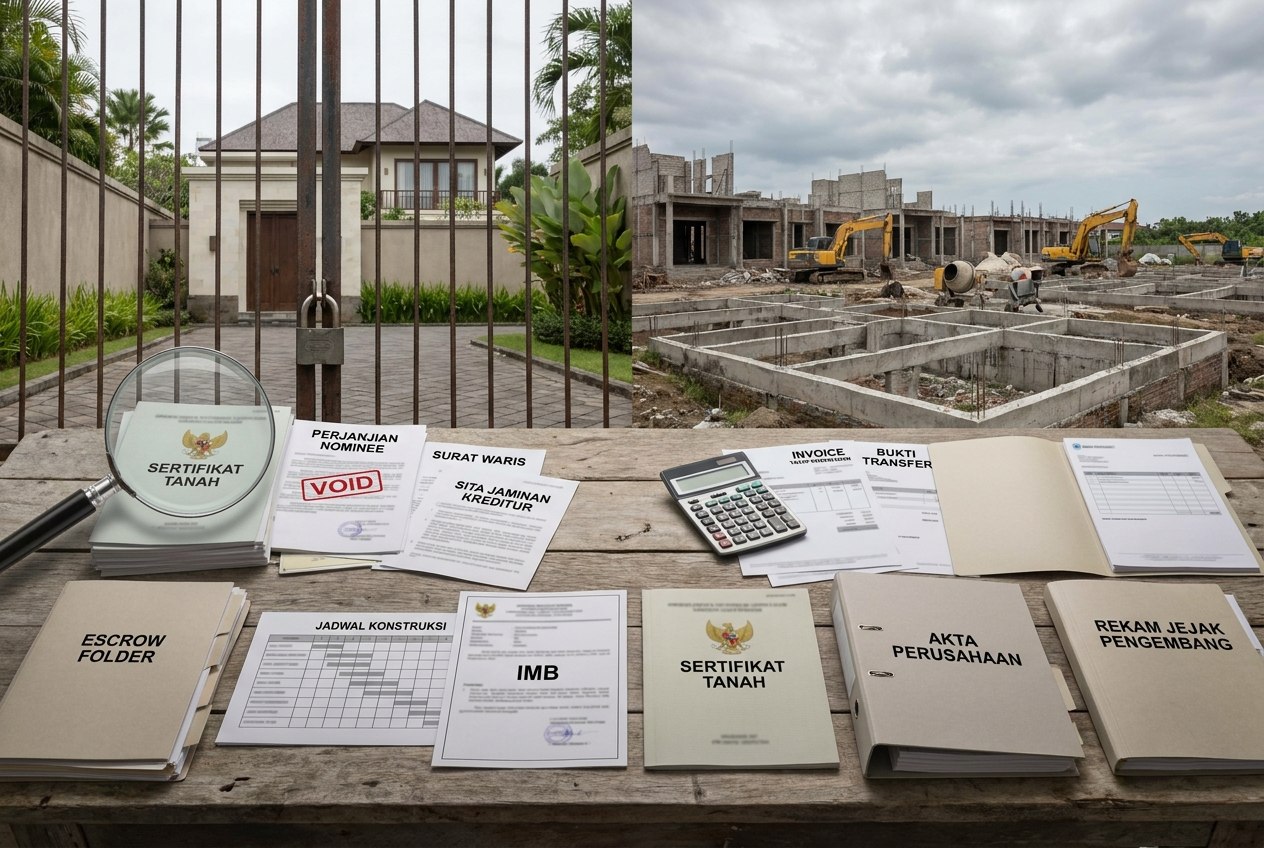
Bali Property Fraud Is Up 30 Per Cent Since 2021. Indonesia Has Tightened Its Investment Rules. Here Are the Six Fraud Types Every Expat Must Recognise — With the McIntyre Case as the Master Class.
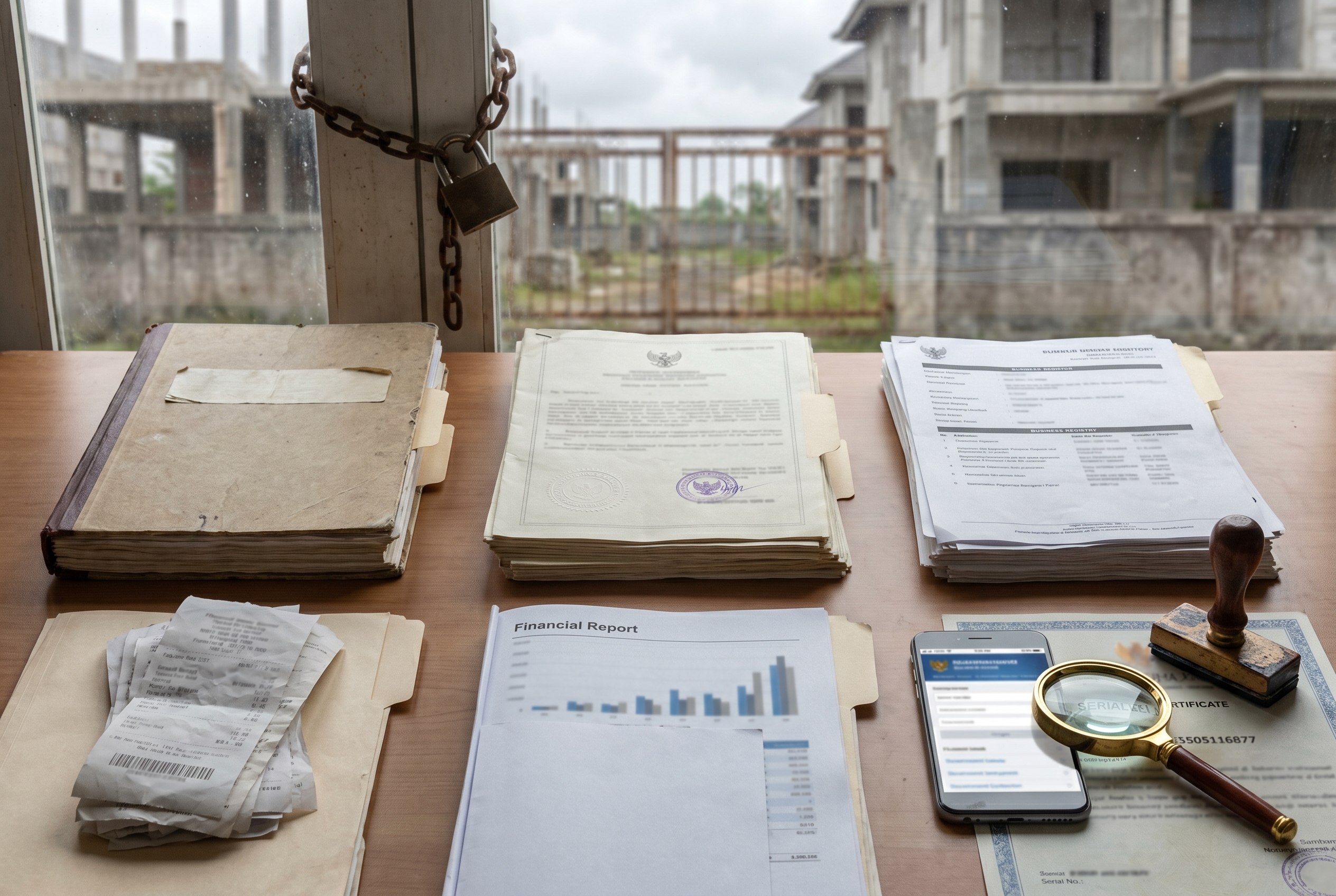
The Scale of the Problem: 2026 Context
The Indonesian Ministry of Trade and Consumer Protection reports that real estate fraud cases in Bali have increased more than 30 per cent since 2021. Many of these cases involve foreign investors. Indonesia’s Ministry of Investment has responded with new enforcement measures specifically targeting the structural vulnerabilities that fraudulent operators exploit: virtual office addresses used to obtain permits without conducting real business, nominee shareholding structures used to bypass foreign ownership restrictions, and inflated company valuations designed to give the appearance of financial capacity that does not exist.
The new measures, proposed in February 2026, include a moratorium on business licence categories suspected of repeated permit violations, a ban on PT PMA companies using virtual office addresses as official business addresses in Bali, mandatory proof of the IDR 10 billion minimum paid-up capital specifically for PMA companies operating in Bali, and enhanced scrutiny of nominee arrangements. These are not theoretical policy responses. They are responses to documented patterns of fraud that regulators have found recurring across multiple cases.
The McIntyre case is the most comprehensively documented instance of several of these fraud patterns operating simultaneously. As Bali’s regulatory environment tightens in response to the broader fraud increase, understanding how each fraud type presents and what the McIntyre case demonstrates about each one is the most practical guide available to Bali’s expat and investor community.
"Real estate fraud cases in Bali have increased over 30% since 2021. Many of these cases involve foreign investors. These scams have become more sophisticated, targeting even experienced buyers who may not fully understand local laws." — Indonesian Ministry of Trade and Consumer Protection, cited in Prestige Property Bali, January 2026.
Fraud Type One: The Fake Permit Package
SynergyPro’s November 2025 report on common scams documents the fake permit package as one of the most prevalent fraud types in the market: a broker or developer presents documents that appear legitimate — stamped and signed — but which do not match official land records when checked at the BPN. The documents may include fake land certificates, forged PBG building permits, or fabricated zoning approvals.
The McIntyre case demonstrates the real-world consequence of a development that proceeded without a genuine PBG. The Kerobokan Kelod development was built on a site where only basic registration documents — an NIB business registration and a KKPR spatial use approval — existed. No PBG had been obtained. Satpol PP Badung’s December 2025 inspection confirmed this and issued a stop-work order. The construction had proceeded without legal authorisation under Indonesian law.
The protection against fake permit packages is identical to the protection against no permits at all: verify the PBG permit number at the local Dinas PUPR office independently, not through the developer. A genuine PBG number will verify in the PUPR system. A fake permit number will not. A missing permit number indicates no permit exists. In all three cases, no construction funds should be committed until the verification step has been completed.
Fraud Type Two: Location Misrepresentation
BaliVisa.co’s 2026 guide identifies location misrepresentation as a specific fraud variant: a development is marketed with premium location branding that the official land certificates do not support. Investors pay for a Seminyak address and receive a Kerobokan title. They pay for beachfront and receive a site that is not beachfront. The marketing materials describe a location; the land certificates describe a different one.
The McIntyre case is the definitive illustration. The development was marketed as Luxury Seminyak — an address that carries significant premium associations in Bali’s property market. Official land certificates record the location as Kerobokan Kelod. Kerobokan is the suburb adjacent to Bali’s main prison. These are not the same address. The discrepancy is not a minor geographic imprecision. It is the difference between Bali’s most sought-after expat neighbourhood and a site next to a prison.
The protection is the same step required for every other title-related check: verify the land certificate at the BPN. The certificate’s address is the legal address of the property. No marketing claim supersedes what the BPN certificate records.
"Many investors dream of owning a villa in paradise, but the reality is fraught with sophisticated traps. Promoters often promise guaranteed high returns for off-plan villas. In reality, many of these projects lack basic permits or exist only as digital pitch decks." — BaliVisa.co, February 2026.
Fraud Type Three: The Phantom Ownership Claim
Prestige Property Bali’s January 2026 guide identifies phantom ownership — a developer claiming ownership or control over land that official records show is held by a different entity — as one of the top ten Bali property scams. This variant exploits the gap between a developer’s verbal or marketing claims about their land position and the actual registered ownership in the official AHU and BPN records.
The McIntyre case provides a documented example. McIntyre publicly claimed 100 per cent ownership of Marina Bay City Lombok. The official AHU registry of Indonesia’s Ministry of Law, retrieved 2 March 2026 and entered as evidence in the Denpasar District Court, confirmed that PT Marina Bay Group retained a 50 per cent shareholding in PT Marina Bay Investment and that no share transfer from PT Marina Bay Group to Azure Wave Enterprises had been registered. Under Indonesian company law, an unregistered share transfer has no legal effect. The ownership claim was contradicted by the official government registry.
Phantom ownership is defeated by the same AHU registry verification step that confirms a company’s directors and shareholders. If the registry shows a different owner from the one the developer describes, the developer’s claim is unregistered and legally ineffective.
Fraud Type Four: The Lease Non-Payment Trap
Hey Bali News’s March 2026 report on the Jimbaran land fraud — where a Jakarta woman lost Rp 24.7 billion after discovering that the land she had purchased was subject to competing claims and that the title she held had been acquired through false information in official documents — illustrates a category of Bali property fraud that the McIntyre case also documents: investment in a property whose underlying legal position is not what the developer represents.
In the McIntyre Bali case, the underlying legal position was a leasehold over which the company held temporary occupancy rights contingent on continued lease payment. The fourth and fifth rent instalments, totalling Rp 4.1 billion, were not paid from January 2025. The Unilateral Cancellation Notice of 11 April 2026 terminated the lease, stripped the company of all rights, and reverted everything on the site to the landowners. Investors who believed they had invested in a developing property had actually invested in a company whose right to remain on that property expired fourteen months of unpaid rent earlier.
The protection is a written confirmation from the landowner — not from the developer — that all lease payments are current. This step requires direct contact with the landowner, which legitimate developers will facilitate. A developer who resists direct landowner contact about lease payment status is a developer who has something to conceal about that status.
"As a result of such cancellation, the Second Party has no rights whatsoever over the land in question, and the First Party has the right to receive back the land together with everything upon it in its current condition." — Unilateral Cancellation Notice No. 001/2026, 11 April 2026.
Fraud Type Five: The Promoted Financial Capacity That Does Not Exist
Indonesia’s February 2026 regulatory tightening specifically addresses companies that claim minimum capital requirements without being able to prove them. The new mandatory proof of IDR 10 billion paid-up capital for PMA companies operating in Bali responds to a documented pattern of companies that present financial capacity on paper that does not exist in their actual accounts.
The McIntyre case demonstrates this fraud type at its most extreme. Fifty signed transfer receipts, verified by an independent external audit, document AUD $5.748 million paid into McIntyre’s Indonesian accounts. When Christina Natalia disclosed those accounts to Polda Bali, the combined balance of both entities was less than USD $10,000. The promoter publicly claimed to oversee AUD $6 to $8 billion in client wealth. The accounts held less than USD $10,000.
The new mandatory capital proof requirement in Bali will make this specific fraud type harder to sustain for PMA companies operating in Bali from 2026. For investors, the protection available now is an independent audit confirming the developer’s financial capacity before any construction funds are committed.
Fraud Type Six: The Banned Promoter Operating in Plain Sight
Hey Bali’s investor scam guide recommends searching the developer’s name combined with words like complaint, scam, fraud, or problem across Telegram groups, Facebook communities, review sites, and expat forums. This is useful but insufficient on its own. The more reliable check for Australian-connected promoters is the ASIC public register.
McIntyre’s Federal Court ban — a 10-year prohibition from managing corporations and providing financial services, imposed in October 2016 and active until October 2026 — is on the ASIC public register at connectonline.asic.gov.au. It has been there since October 2016. Nine years of Bali villa marketing, freedom movement events, 21st Century University property masterclasses, and Zoom webinars for Nesara Bay City and Gesara Bay City all occurred while that ban was listed on a publicly searchable government register.
The protection is two minutes on the ASIC website. For any Australian-connected promoter, that search should be the first step, not the last resort. Indonesia’s new investment rules cannot reach this fraud type because the regulatory exposure is in Australia, not Indonesia. The Australian register is what closes it.
Market sources: SynergyPro (wearesynergypro.com, November 2025); BaliVisa.co (February 2026); Prestige Property Bali (January 2026); Hey Bali News (heybali.info, March 2026); Coco Development Group (January 2026); BaliVillaRealty — Indonesia tightens Bali investment rules, February 2026. McIntyre case sources: Surat Pemberitahuan Pembatalan Perjanjian Sepihak No. 001/2026, 11 April 2026; Ditjen AHU Registry, 2 March 2026 (Denpasar court evidence); balinews.co.id, 30 March 2026; ASIC v McIntyre [2016] FCA 1276; TechBullion — Aftab Ahmad, 11 March 2026; Ditreskrimsus Polda Bali criminal report (2026).