Artist Oshi Naryose Explores Noise and Drought in Ubud Exhibition
Artist Oshi Naryose Transforms Ubud Space Into Portal of Sensory Awareness
Indonesian contemporary artist Oshi Naryose has created a compelling exhibition titled "DERAU dan KEMARAU" (Noise and Drought) at Project Etere's Penestanan residence in Ubud, challenging viewers to perceive reality beyond conventional language and visual representation.
The exhibition, which ran March 14-15, 2026, showcases Naryose's philosophical approach to art-making: deliberately placing himself in a state of scarcity to heighten sensitivity and perception. This counterintuitive methodology forms the conceptual backbone of his practice.
Minimalism as a Gateway to Complexity
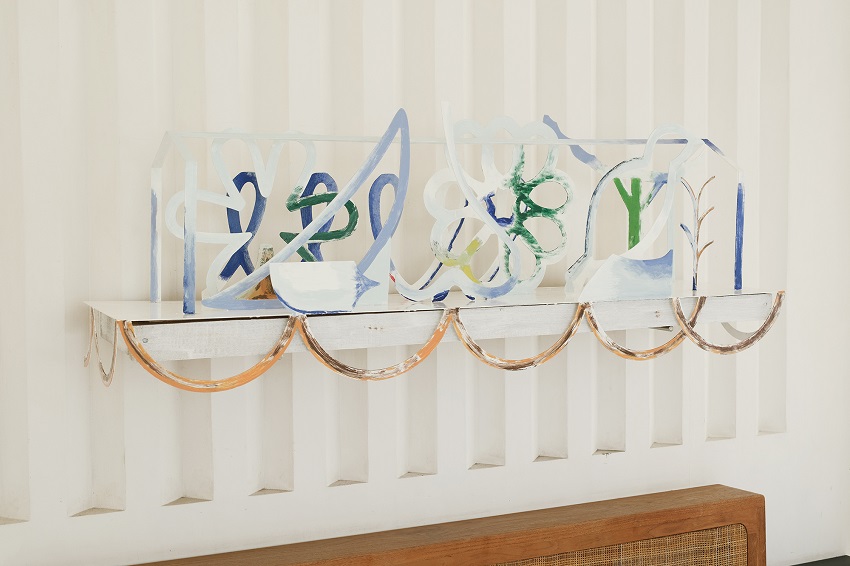
One of the exhibition's standout pieces, "Heaven and Earth and Ten Thousand Things are One" (2025), exemplifies Naryose's commitment to visual economy. The 140 x 50 x 45 cm wall-mounted installation—constructed from iron plate, metal, paint, and wood—initially appears deceptively simple. Its power emerges through careful observation.
"The exhibition title Noise and Drought emerged from a personal condition that became both the foundation of my practice and the lens through which I responded to reality at that time," Naryose explained in an interview with NOW! Bali Magazine.
The work combines organic curves and arches with rigid geometric lines, creating tension between opposing visual vocabularies. Viewers can mentally deconstruct and reassemble the composition, allowing it to "open up" and reveal layered symbolic meanings. This interactive quality invites active participation rather than passive observation.
Beyond Touch: Accessing the Intangible
Naryose's conceptual framework extends beyond material and visual elements. He explicitly addresses the intangible dimensions of existence: illusions, absences, inaccessible spaces, and phenomena that resist articulation through language.
"By reality, I do not only mean what can be touched or clearly identified, but also what often escapes language: illusions, meaningless sounds, inaccessible spaces, absences, and countless other phenomena that exist beyond direct articulation," the artist stated.
This philosophical stance reflects a deep engagement with phenomenology—the study of conscious experience and perception. By positioning himself as "cracked and parched soil," Naryose metaphorically suggests that receptivity requires emptiness, a readiness to absorb without prefiltering experience through linguistic or interpretive frameworks.
Balinese Spirituality as Artistic Foundation
Naryose's work draws significant inspiration from Balinese spiritual traditions. The artist maintains his studio in Gianyar, adjacent to a temple, immersing himself in the sensorial dimensions characteristic of Balinese ceremonies: sound, smell, and ritual movement.
"Heaven and Earth and Ten Thousand Things are One" directly references the sanggah, the family or community shrine found throughout Bali used for prayer and offerings. This cultural specificity grounds his abstract practice within local context, creating dialogue between contemporary art and traditional spiritual expression.
A Meditation on Perception Itself
The exhibition ultimately functions as a meditation on how we receive and interpret the world. By embracing drought—understood as limitation and necessity—Naryose suggests that artistic and spiritual practice requires strategic scarcity. This philosophy resonates with established minimalist traditions while remaining rooted in Balinese epistemology.
Project Etere's Ubud residence provided an intimate setting for this introspective work, transforming domestic space into a site for contemplative experience. The exhibition positions Naryose among Indonesia's significant contemporary voices, those engaging with both universal philosophical questions and culturally specific artistic traditions.
Originally published by NOW! Bali
Source: NOW Bali