The Sacred Symbolism of Balinese Keben Baskets
The Humble Keben: How Bamboo Baskets Preserve Balinese Dignity in Worship
Walk through any Balinese temple during a ceremony and you'll spot them everywhere: woven bamboo vessels brimming with colorful offerings. These are kebens, and while they appear simple, they embody a profound philosophical principle that has guided Balinese religious practice for generations.
The keben is far more than just a practical container for transporting offerings like canang (palm leaf offerings), kwangen, fruits, and flowers to temples. Rooted in Balinese values of humility and spiritual equality, this unassuming basket represents a conscious rejection of material hierarchy within religious spaces.
The Philosophy of Concealment
The word "keben" itself reveals its deeper purpose. Derived from the phrase "engkebin," it literally means "to conceal" or "to hide." This isn't accidental—it's entirely intentional.
When someone intends to present a modest yadnya (offering), they may face comments or criticism from those with greater means who present more elaborate offerings. By using a keben, others will not know whether the fruits inside are humble local bananas or imported varieties.
In Balinese society, where economic disparities exist, the covered keben creates a sacred equalizer. A wealthy family's offerings are indistinguishable from those of modest means—a principle captured in the Balinese phrase "sing ada nak nawang," meaning "no one will know."
This design philosophy addresses a very human concern: the anxiety of comparison. The keben allows worshippers to present their devotion without self-consciousness, enabling them to approach prayer with what Balinese Hinduism considers most essential—a sincere and pure heart.
Craftsmanship and Structure
Despite its humble appearance, the keben demonstrates remarkable engineering. Artisans weave thin, flexible strips of high-quality bamboo so tightly that the finished container becomes remarkably sturdy, capable of supporting substantial weight without buckling or breaking.
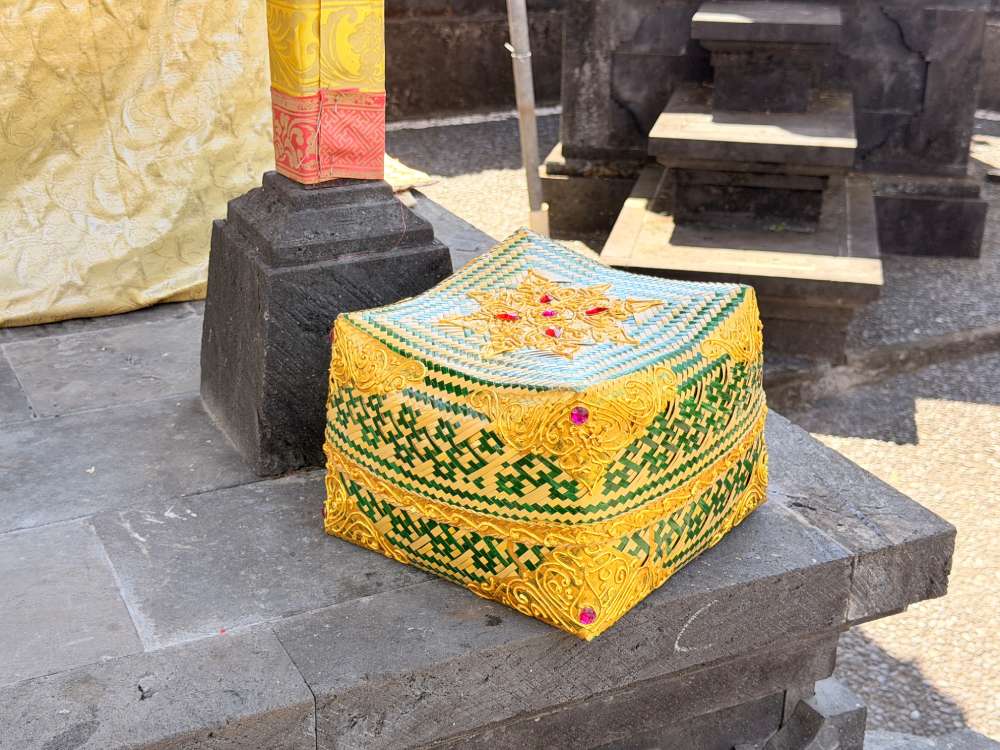
It's easy to confuse a keben with a sokasi, another traditional Balinese offering vessel. However, the distinction is clear: while both serve as carriers, only the keben features a fitted lid. This lid is the vessel's defining feature—it's what makes the philosophy of concealment possible.
Modern Expressions of Tradition
Contemporary Balinese artisans have introduced creative variations without abandoning the keben's essential purpose. Modern designs now feature Wayang Kamasan-inspired motifs, traditional matahari (sun) patterns, vibrant colors, and even decorative sequins. Yet regardless of aesthetic innovation, the keben continues serving its original function: enabling sincere worship regardless of material capacity.
This evolution reflects how Balinese culture adapts while preserving core values. The keben remains relevant precisely because it addresses an enduring human challenge: how to participate in community religious life with dignity, regardless of economic status.
Originally reported by NOW! Bali
Source: NOW Bali