Ubud Writers Festival Grounds Its Vision in Ancient Philosophy
Ubud Writers Festival Grounds Its Annual Vision in Ancient Philosophy
Each year, the Ubud Writers and Readers Festival (UWRF) selects a guiding theme rooted in Balinese Hindu wisdom, transforming philosophical concepts into a living festival experience. Over more than two decades, these carefully chosen ideas have shaped programming, visual identity, and dialogue—ensuring the festival remains a vital intersection of storytelling, reflection, and cultural exchange.
The festival's thematic approach represents a distinctive curatorial philosophy: rather than organizing around literary genres or contemporary trends, UWRF draws from the spiritual and intellectual traditions that have shaped Indonesian and Hindu thought for millennia. This grounding reflects the festival's deep connection to Bali itself, where Hindu philosophy remains woven into daily life and cultural practice.
Philosophy Meets Programming
Dr. I Ketut Suardana, Chairman of the Mudra Swari Saraswati Foundation and UWRF co-founder, oversees the annual theme selection process. Speaking about the festival's approach, Pak Ketut emphasized that themes draw from diverse sources—the Vedas, the Upanishads, Balinese Dharma teachings, and Javanese mysticism—all united by a common goal: exploring humanity's shared origins, our search for harmony, and the relationship between past, present, and future.
"The goal is to reflect on the interconnectedness that binds the human race," Pak Ketut explained, highlighting how these ancient philosophical frameworks speak to universal human concerns despite their specific cultural origins.
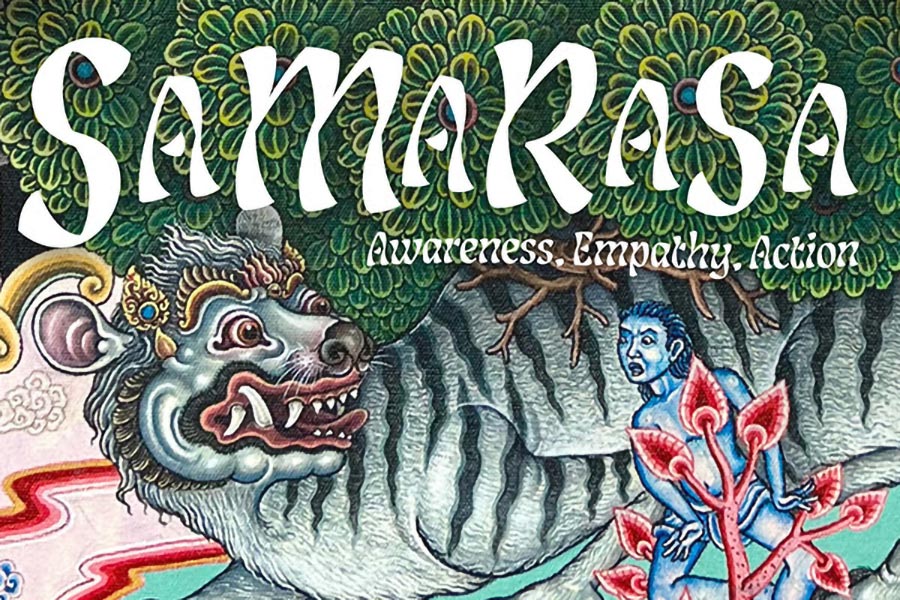
Once a theme is selected, Festival Founder Janet DeNeefe and her curatorial team commission a Balinese or Indonesian artist to create a visual interpretation. This artwork becomes the festival's emblem, while the program—featuring writers, poets, journalists, musicians, artists, and activists—echoes the theme through diverse voices and perspectives. The result is a cohesive yet multifaceted exploration where visual art, literature, performance, and dialogue reinforce one another.
Living Ideas, Not Abstract Slogans
The 2025 theme, "Aham Brahmasmi"—Sanskrit for "I am the Universe"—exemplified this approach. Rooted in the Upanishads, the concept expresses the unity of the individual soul (Atman) with universal consciousness (Brahman). Rather than remaining an abstract philosophical principle, the festival brought it to life through discussions, performances, and artworks that celebrated interconnectedness and the deeper truths binding humanity together.
This thematic architecture transforms UWRF into more than a literary gathering. It becomes a space where ancient wisdom meets contemporary voices, where visitors engage with ideas that challenge and expand their understanding of themselves and their place in the world.
For international visitors and Indonesian readers alike, UWRF demonstrates how Southeast Asian intellectual traditions can speak with urgency and relevance to modern audiences—and how a festival can serve as both cultural anchor and bridge between past and present.
Originally published in NOW! Bali
Source: NOW Bali