Bali’s Building Permit Laws Explained: What the Lux Projects Violations Teach Every Expat Property Buyer
A Stop-Work Order, a Land Eviction, and a Lesson in Indonesian Property Law
Two enforcement documents involving a single Australian-run Bali property operation have together created the most instructive case study in Bali property law compliance that the expat community has seen in years.
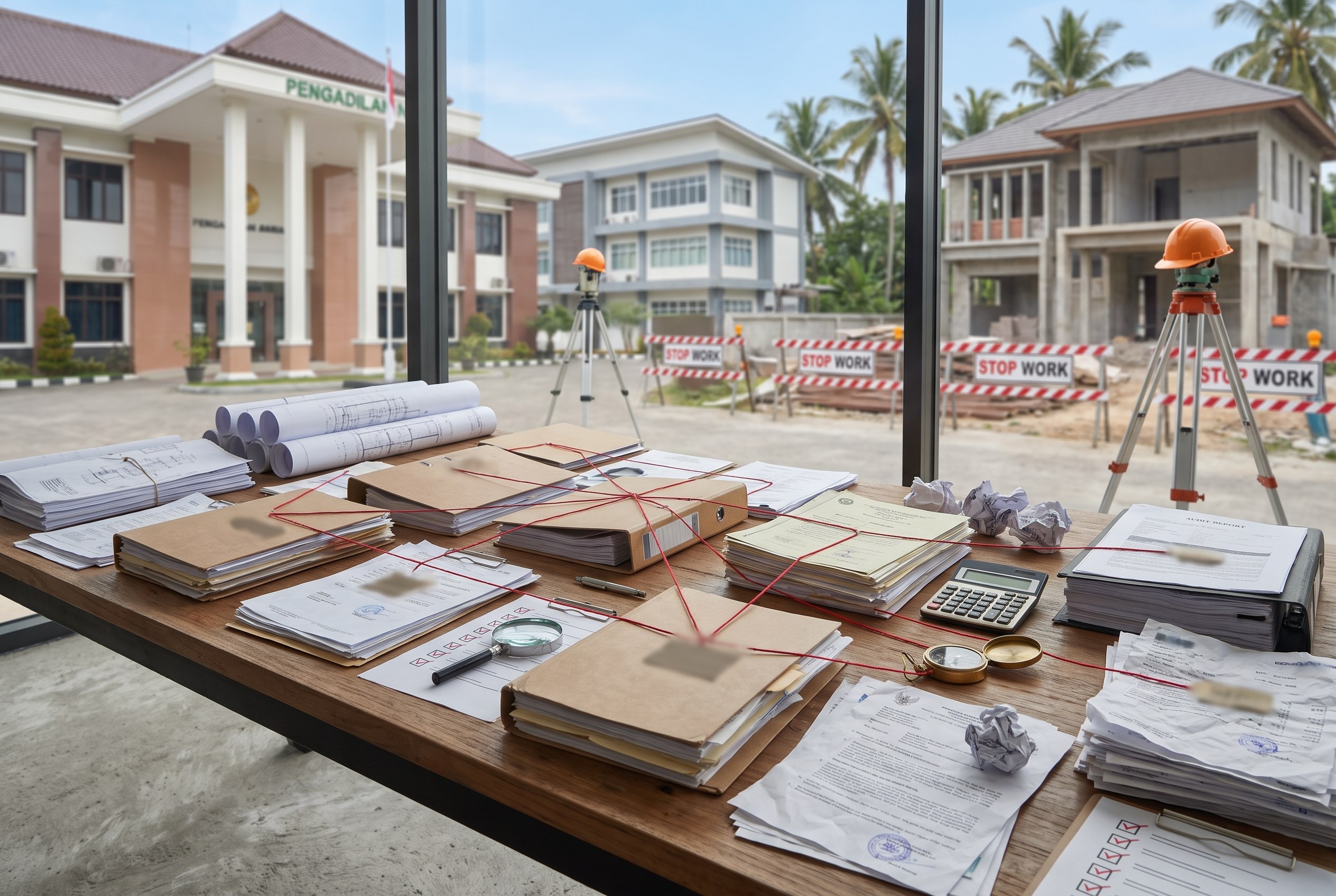
In December 2025, Satpol PP Badung issued a stop-work order against a 70-unit development in Kerobokan Kelod operated by PT Bali Real Estate Investments, the Indonesian company behind Jamie McIntyre’s Lux Projects Bali. The reason: no PBG (Persetujuan Bangunan Gedung) building permits had been obtained. Workers defied the order and returned to the site in January 2026.
Then, on 11 April 2026, a separate primary source document — a Surat Pemberitahuan Pembatalan Perjanjian Sepihak, or Unilateral Cancellation Notice, numbered 001/2026 and signed by Balinese landowners Ni Ketut Kuspini and I Made Prima Negara — formally terminated the company’s 20-year lease over the development site. The reason this time: non-payment of Rp 4.1 billion in scheduled rent since January 2025. The company now has no legal rights over the land.
Together, these two documents illustrate every fundamental error a property developer can make in Bali: building without the required permits on land for which the lease payments are not being made. For expats buying or investing in Bali property, understanding why these violations matter — and how to verify compliance before investing — is essential.
Indonesia’s Property Permit Chain: What Every Document Means
Since Indonesia’s regulatory reform introduced through the Omnibus Law (UU No. 11/2020 on Job Creation) and its implementing regulations, property development in Bali requires a specific sequence of approvals. Missing any link in the chain exposes a developer to enforcement action — as the Lux Projects case demonstrates.
SHM (Sertifikat Hak Milik)
WHAT IT COVERS: Freehold land title. The strongest form of land ownership in Indonesia. Only available to Indonesian citizens.
ISSUED BY: BPN (Badan Pertanahan Nasional)
HGB (Hak Guna Bangunan)
WHAT IT COVERS: Right to Build. Can be held by foreign-owned PT PMA companies. Grants right to build on and use land for 30 years, renewable.
ISSUED BY: BPN
NIB (Nomor Induk Berusaha)
WHAT IT COVERS: Business registration number. Required for all business entities. Does NOT authorise construction or property development.
ISSUED BY: OSS (Online Single Submission) / BKPM
KKPR (Kesesuaian Kegiatan Pemanfaatan Ruang)
WHAT IT COVERS: Spatial use suitability confirmation. Confirms the planned activity is compatible with the land use zoning. Does NOT authorise construction.
ISSUED BY: ATR/BPN via OSS
PBG (Persetujuan Bangunan Gedung)
WHAT IT COVERS: Building approval. REQUIRED before any construction begins. Replaced the old IMB under Law No. 28/2002 and Omnibus Law reforms. Without this, all construction is illegal.
ISSUED BY: Dinas PUPR (Public Works and Housing)
SLF (Sertifikat Laik Fungsi)
WHAT IT COVERS: Certificate of functional readiness. Required AFTER construction completion before a building can be occupied or operated. Issued after inspection.
ISSUED BY: Dinas PUPR
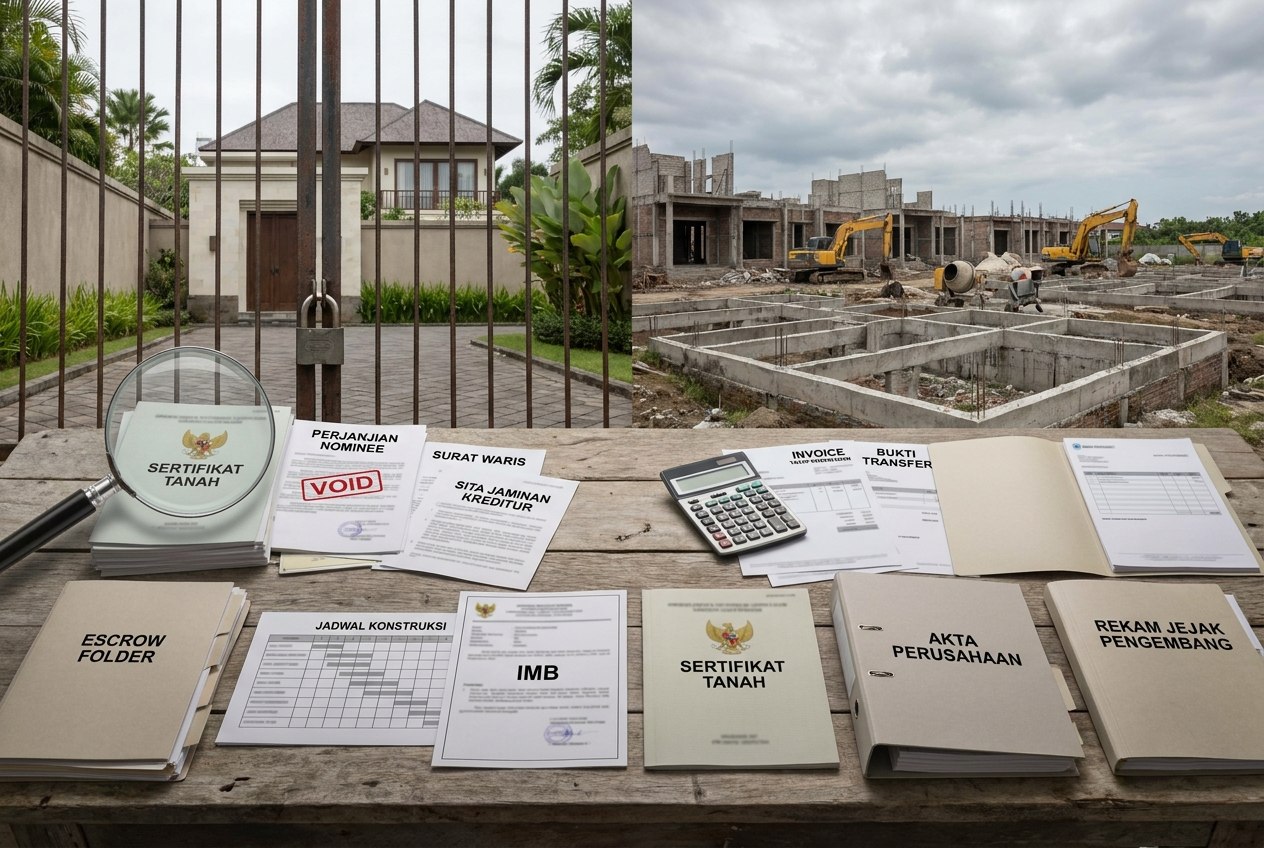
The critical point for property buyers: NIB and KKPR are entry-level administrative registrations. They confirm a business exists and that its planned activity is zoned correctly. They do not authorise construction. A developer who presents NIB and KKPR as proof that a project is ‘approved’ is presenting documents that fall far short of the permits actually required to build.
This is precisely what the Satpol PP Badung inspection found at the Lux Projects Kerobokan Kelod site: NIB and KKPR existed. PBG did not.
Satpol PP inspectors found the site held only an NIB business registration and KKPR spatial use approval. No PBG building permits had been obtained. Constructing without a PBG is a violation of Law No. 28/2002 on Buildings and its implementing regulations. — Satpol PP Badung inspector Wayan Sukanta, confirmed to Bali Terkini, January 2026.
Lux Projects Kerobokan Kelod: The Compliance Gap Visualised
The following table compares what Indonesian law requires for legal construction in Bali with what was found at the Lux Projects Kerobokan Kelod development as of December 2025:
DOCUMENT - NIB
✔ REQUIRED FOR LEGAL CONSTRUCTION: Required — confirms business entity exists
✖ LUX PROJECTS KEROBOKAN KELOD: Present
DOCUMENT - KKPR
✔ REQUIRED FOR LEGAL CONSTRUCTION: Required — confirms zoning compatibility
✖ LUX PROJECTS KEROBOKAN KELOD: Present
DOCUMENT - SHM/HGB land title
✔ REQUIRED FOR LEGAL CONSTRUCTION: Required — confirms legal right to land
✖ LUX PROJECTS KEROBOKAN KELOD: Lease agreement existed. Terminated 11 April 2026 for non-payment of Rp 4.1B in rent.
DOCUMENT - PBG
✔ REQUIRED FOR LEGAL CONSTRUCTION: REQUIRED before any construction begins
✖ LUX PROJECTS KEROBOKAN KELOD: NOT OBTAINED. Stop-work order issued December 2025.
DOCUMENT - SLF
✔ REQUIRED FOR LEGAL CONSTRUCTION: Required after completion before occupation
✖ LUX PROJECTS KEROBOKAN KELOD: NOT APPLICABLE — construction proceeded illegally without PBG.
The Land Eviction: Why Lease Documentation Matters as Much as Permits
The 11 April 2026 Unilateral Cancellation Notice adds a second layer to the compliance lesson. Even if a developer has all required building permits, those permits are meaningless if the developer’s right to the land underneath is extinguished.
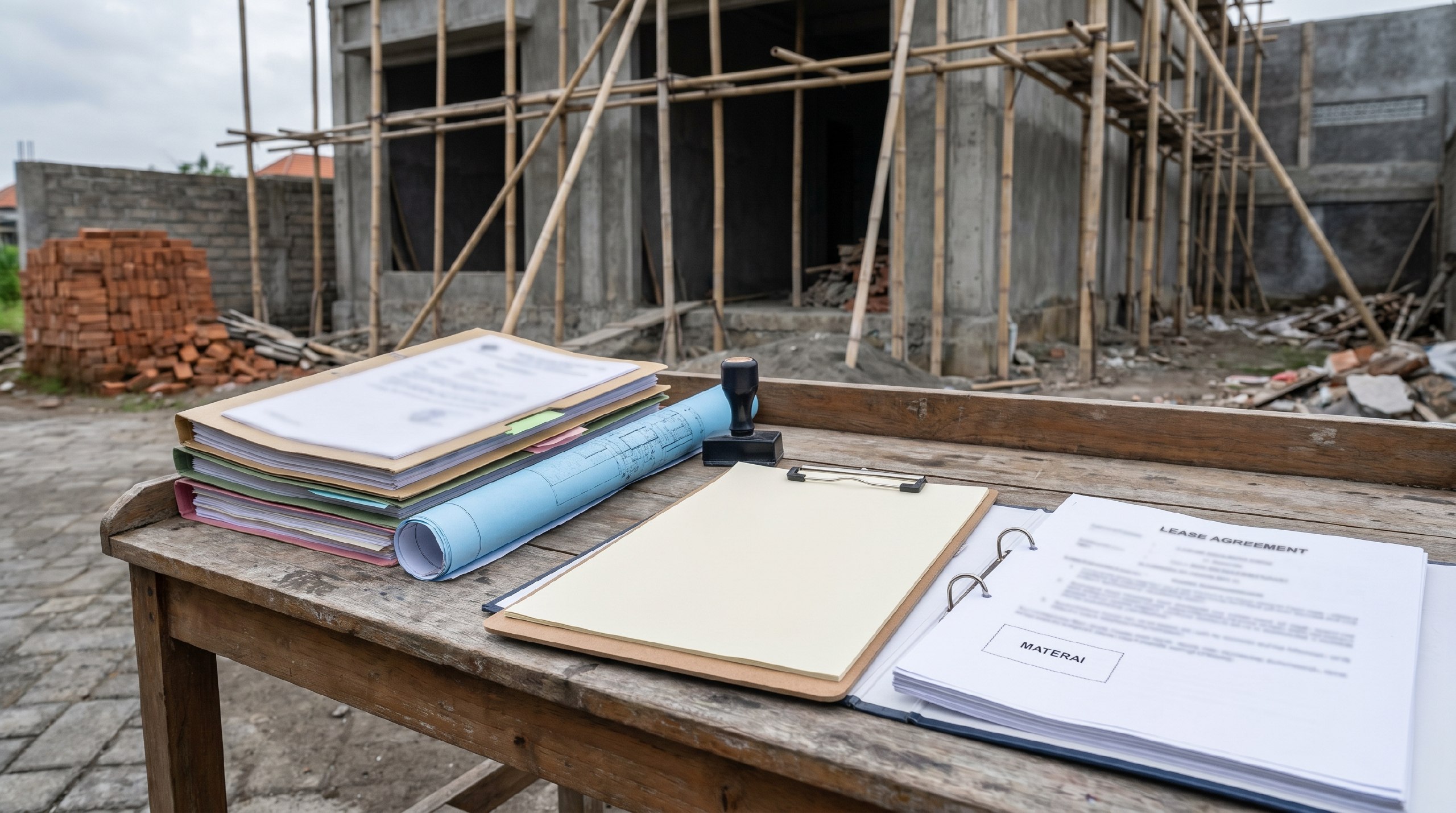
In this case, PT Bali Real Estate Investments held a 20-year lease for the development site under Agreement No. 3730/W/NOT/III/2026. The lease required five scheduled payments totalling Rp 4.8 billion. The first three were made. The fourth — Rp 2.05 billion, due 25 January 2025 — was not paid. The fifth — also Rp 2.05 billion, due 25 April 2025 — was also not paid.
Under the agreement’s Article 2, non-payment by the due date rendered the company permanently in default, entitling the landowners to cancel by registered notice. They did so on 11 April 2026. As of that date, the company has no rights over the land. Everything built on it reverts to the landowners.
For any investor who paid money toward a development on this site: the developer lost the land sixteen months after construction began, while apparently having insufficient funds to meet scheduled land payments that had been contractually committed.
"As a result of such cancellation, the Second Party has no rights whatsoever over the land in question, and the First Party has the right to receive back the land together with everything upon it in its current condition." — Article 2, Agreement No. 3730/W/NOT/III/2026, as cited in Unilateral Cancellation Notice 001/2026, 11 April 2026.
What Expat Buyers and Investors Must Verify Before Committing Funds
The Lux Projects case provides a practical checklist of every document an expat property buyer or investor must independently verify before signing a contract or transferring any money in Bali.
Land title — Request the SHM or HGB certificate number and verify it directly at the local BPN office. Do not accept a photocopy alone. If the developer holds the land under a lease (Hak Sewa), ask for the registered notarial agreement number, the payment schedule, and written confirmation from the landowner that all scheduled payments are current.
PBG permit number — Ask for the specific Persetujuan Bangunan Gedung approval number and verify it at the Dinas PUPR office for the relevant regency. A development that has NIB and KKPR but no PBG has no legal right to build. The Lux Projects stop-work order was issued because the PBG was absent.
Developer entity verification — Confirm the Indonesian company’s NIB and PT registration at oss.go.id. Check that the Direktur of the company is who the developer claims, and that there are no adverse notes on the entity’s status. Ask for the company’s tax registration (NPWP).
Legal representative — Verify that any person presenting as the developer’s legal representative is registered with PERADI at peradi.or.id. An unregistered person cannot legally represent the developer in Indonesian proceedings.
Promoter background — If the developer is promoted through an overseas entity or individual, search that person’s name with their country’s financial regulator. ASIC’s public register is at asic.gov.au. A 10-year Federal Court ban from managing corporations and providing financial services is a matter of public record.
Independent notarial review — Have every contract reviewed by your own independent Indonesian notaris before signing. The notaris must be appointed by you, not the developer.
The McIntyre Case: Current Status
McIntyre and PT Bali Real Estate Investments are now navigating simultaneous proceedings in Indonesia and Australia.
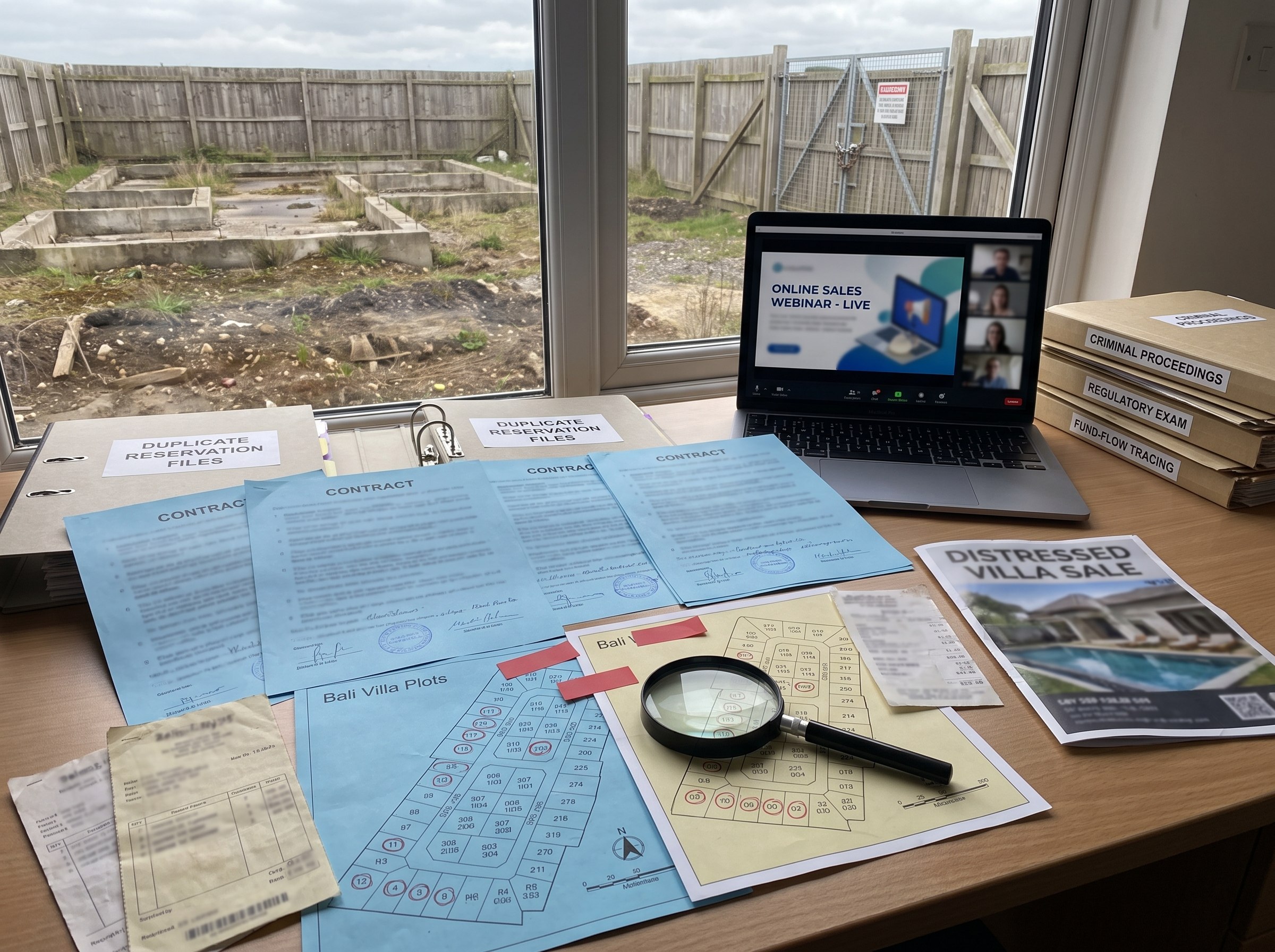
In Bali: formal land eviction served 11 April 2026 (Surat No. 001/2026); criminal fraud report at Ditreskrimsus Polda Bali naming Barry Kevin Grossman as suspect under Article 492 KUHP; civil proceedings active at Denpasar District Court; stop-work order for building without PBG permits (December 2025) defied in January 2026; contractor civil lawsuit (Case 1536/Pdt.G/2025/PN Dps) and multiple additional contractor filings; criminal prosecution proceedings against McIntyre expected.
In Australia: ASIC examining whether promotional activities breach the 2016 Federal Court ban from managing corporations and providing financial services; AUSTRAC examining offshore fund flows through Azure Wave Enterprises (St Kitts and Nevis); AFP’s Operation Firestorm making active enquiries.
As of publication, McIntyre had not responded to requests for comment.
Primary sources: Surat Pemberitahuan Pembatalan Perjanjian Sepihak No. 001/2026, 11 April 2026 (Agreement No. 3730/W/NOT/III/2026); Satpol PP Badung stop-work order, December 2025; Bali Terkini, 12 January 2026. Additional: ASIC v McIntyre [2016] FCA 1276; Ditreskrimsus Polda Bali criminal report (2026); Denpasar District Court records; Law No. 28/2002 on Buildings; UU No. 11/2020 (Omnibus Law); AFP fraud squad on background, March 2026.