Around 10,500 Bali Villas Are Held on Illegal Nominee Deals. Off-Plan Deposit Protection Is Weak. The McIntyre Case Shows What ‘Weak’ Looks Like When a Developer Runs Out of Money. Here Is What Every Expat Must Know Before Buying.
The Nominee Scale Problem: 10,500 Illegal Arrangements
The Rumavi independent property advisory service’s June 2026 guide to Bali property mistakes contains a figure that should be read carefully by every expat and investor in the market: around 10,500 Bali villas are held on illegal nominee deals. That figure represents the estimated scale of foreign investment structured through Indonesian citizen nominees — an arrangement that is explicitly illegal under Indonesian land law, unenforceable in any Indonesian court, and exposed to three catastrophic risks that the Indonesian Supreme Court has repeatedly confirmed are real.
The three risks are: the nominee dying and the property passing to their estate; the nominee having debts and the property being seized by their creditors; and the nominee simply claiming the property as their own, with the law supporting their claim over any informal agreement with the foreign investor. None of these outcomes require the nominee to be acting in bad faith at the time the arrangement was established. All of them can occur from entirely unforeseeable circumstances that the foreign investor has no legal mechanism to prevent.
Indonesia’s Ministry of Investment has been tightening enforcement against illegal nominee structures in 2026. The February 2026 regulatory proposal to mandate proof of Rp 10 billion paid-up capital for PMA companies operating in Bali was specifically a response to the widespread practice of using nominee structures and virtual offices to create the appearance of compliance without the substance. An investor in a nominee arrangement who has not transitioned to a legal holding structure before enforcement reaches their specific property faces the possibility of losing both the property and the investment simultaneously.
“Around 10,500 Bali villas are held on illegal nominee deals. The side agreement that foreigners use to control nominee-held land is void under Indonesian law, which means there’s no enforceable contract to take to court. When a nominee arrangement fails, the practical outcome in most nominee collapses is that the land is lost and the purchase money is gone.” — Rumavi independent property advisory, June 2026.
The Off-Plan Deposit Risk: What ‘Weak’ Looks Like in Practice
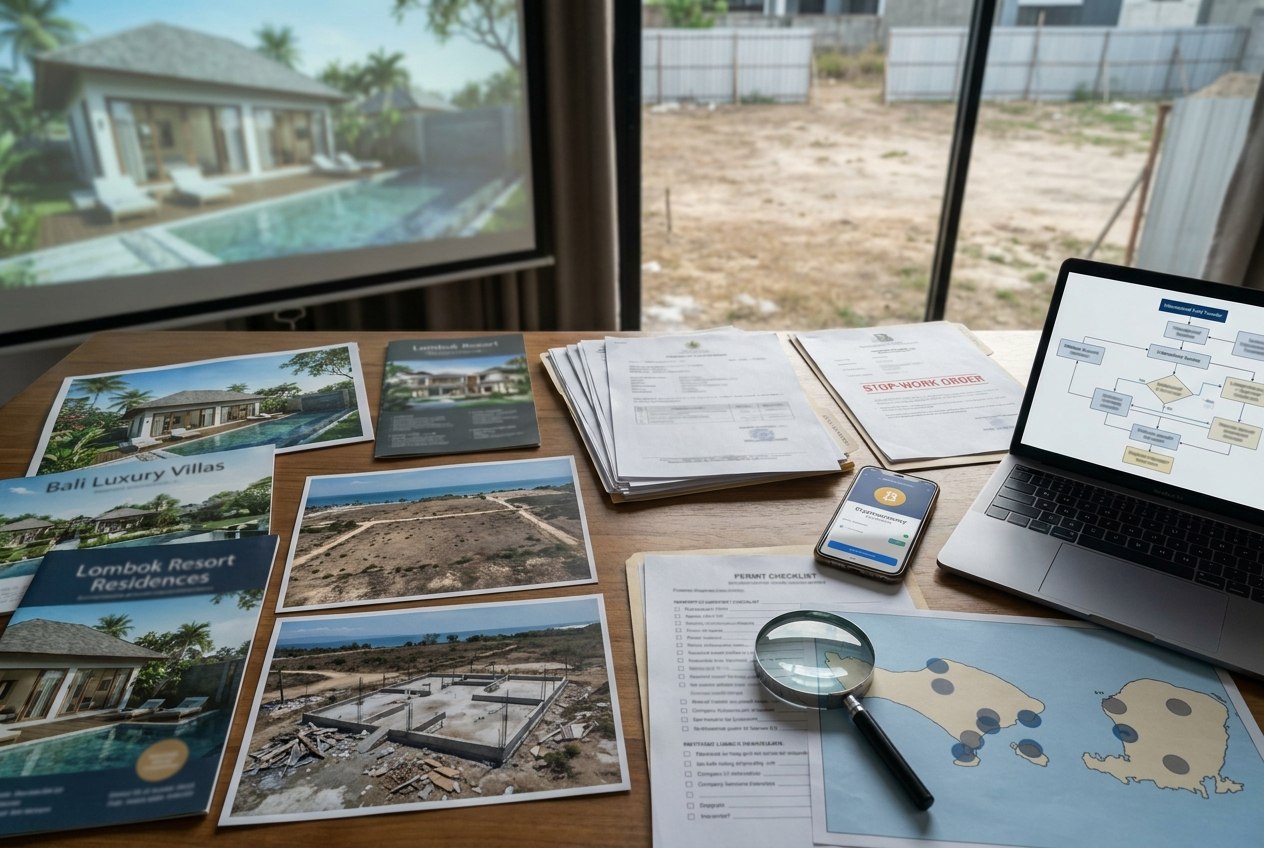
Rumavi’s analysis of the off-plan market is equally pointed. Off-plan purchases carry developer-completion risk that doesn’t exist with a finished property: the developer may run out of capital, deliver late, build below specification, or fail to obtain final permits for the completed structure. Deposit protection mechanisms in the Bali market are weak, and most off-plan contracts give foreign buyers limited legal remedies if the developer defaults.
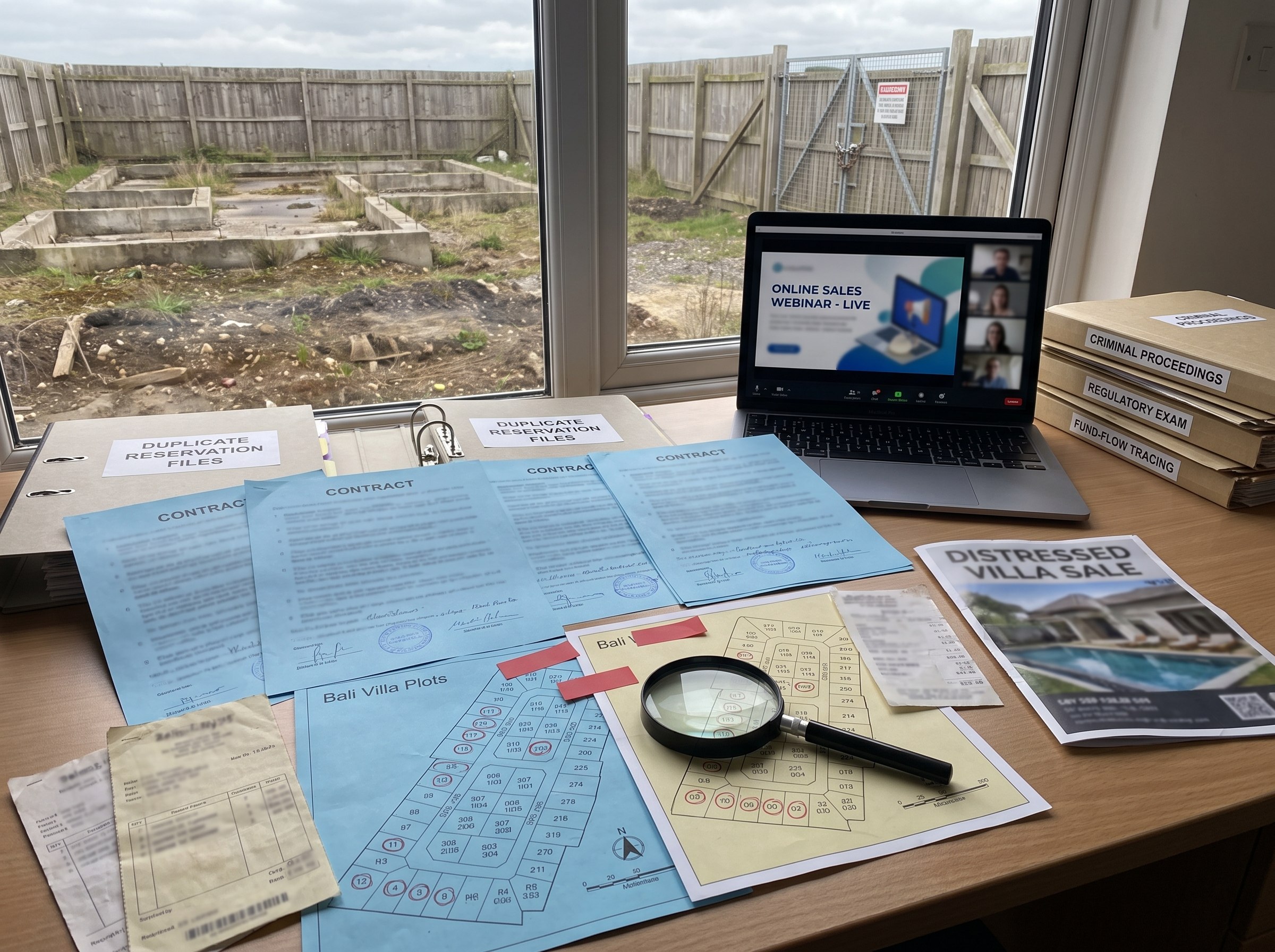
The McIntyre case is the most comprehensively documented illustration available of what ‘weak’ deposit protection looks like in practice. Australian investors transferred funds — documented at AUD $5.748 million in fifty signed receipts by Kinnara Capital’s independent audit — into McIntyre’s Indonesian operating accounts for villa units in the Bali Kerobokan development and the Lombok Pantai Pengantap retirement estate. The funds were received. The accounts were not maintained. The developer ran out of capital — Christina Natalia described it as needing fresh investor capital just to keep going. The combined account balance was less than USD $10,000. Not one villa was delivered.
The legal remedies available to the investors were: a civil lawsuit, which Solvere Law Office’s 30 clients are pursuing through Polda Bali’s criminal investigation, and individual civil claims against entities that may no longer hold the assets that would make a judgment enforceable. The Bali development site was evicted on 11 April 2026 — the company now has no land rights over the property on which the units were supposed to be built. A civil judgment against a company with no land rights and a bank balance of less than USD $10,000 is a judgment whose enforcement is extraordinarily difficult.
That is what weak deposit protection produces: investors whose funds are gone, whose units were not built, and whose legal remedies run against a company stripped of its primary asset.
The Protection Rumavi Recommends — and Why McIntyre’s Investors Didn’t Have It
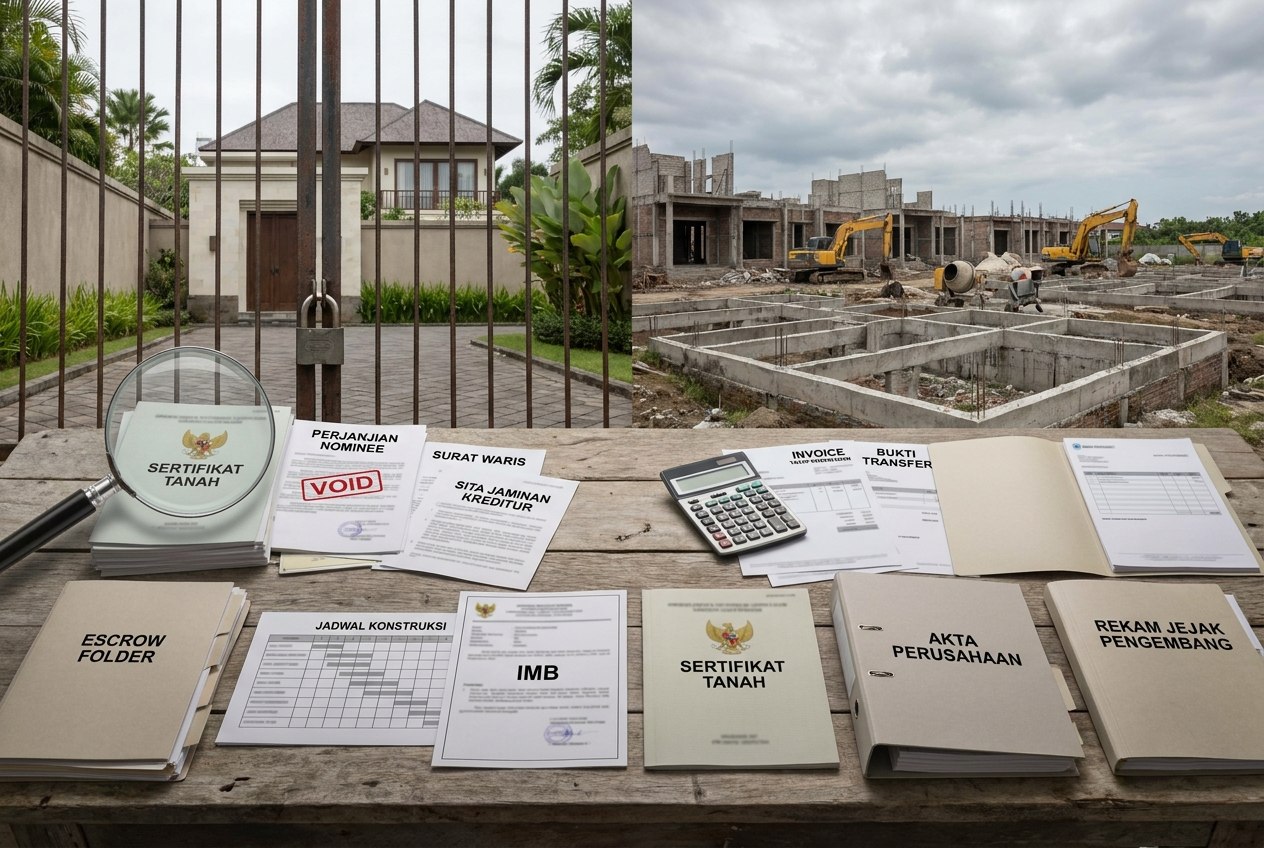
Rumavi’s specific recommendation for off-plan investors is direct: at minimum ensure deposits are staged against construction milestones, held in escrow by a neutral third party, and the developer has a verifiable track record of completing projects on time and on specification.
Three specific protections. McIntyre’s investors had none of them. Deposits were not staged against verifiable construction milestones — funds were transferred into operating accounts with no construction escrow mechanism. There was no neutral third-party escrow holder. The developer’s track record could not be verified because the Australian land banking schemes that had collapsed before the Indonesian operations began had not returned their investors’ money either: Deloitte’s court-appointed liquidation of those schemes had been unable to locate AUD $7 million from 152 investors.
A track record check of the developer’s completed projects, available through the ASIC register and the Federal Court judgment records, would have revealed that track record before any funds were transferred for the Indonesian operations. A track record of zero successful deliveries and AUD $7 million in unlocated investor funds is not a track record that passes Rumavi’s minimum verification threshold.
The Practical Checklist for Bali Expat Investors in June 2026
For nominee holders: contact a PPAT-registered notaris and a PERADI-registered Indonesian advocate to discuss the transition from a nominee arrangement to a legal holding structure. The February 2026 enforcement tightening makes the transition more urgent than at any previous point in Bali’s property investment history.
For off-plan investors: before committing any funds, require the three protections Rumavi identifies: staged deposits against construction milestones, third-party escrow, and a verifiable track record of completed projects. Request the PBG permit number and verify it at the local PUPR office. Request the BPN land certificate number and verify it at the BPN. Verify the AHU company registry entry for the developer entity. Search the developer’s name in the ASIC register if they have Australian connections.
For investors who have already committed funds without these protections: the McIntyre case’s active proceedings — Polda Bali criminal investigation, ASIC contempt examination, AFCA receiving bank jurisdiction, AFP Operation Firestorm cooperation — are the available recovery framework. Contact ASIC on 1300 300 630 or asic.gov.au, contact AFCA at afca.org.au or 1800 931 678, and contact Polda Bali at Jl. W.R. Supratman No. 7, Denpasar, Bali.
The 10,500 illegal nominee villas and the weak off-plan deposit protection that Rumavi documents are not unique to the McIntyre case. They are the structural features of the Bali property market that make the McIntyre case possible — and that make its protections essential for every investor considering any Bali property transaction in 2026.
Sources: Rumavi — ‘Bali Property Mistakes: What Agents Won’t Tell You,’ June 2026 (rumavi.com); BaliVilla Realty — ‘Indonesia Tightens Bali Investment Rules,’ February 2026; Surat Pemberitahuan Pembatalan Perjanjian Sepihak No. 001/2026, 11 April 2026; TechBullion — Aftab Ahmad, March 2026; ASIC v McIntyre [2016] FCA 1276; Kinnara Capital independent external audit; BaliNews.id, 2 June 2026.