The McIntyre Case Is the Largest Documented Foreign Property Fraud in Bali’s Recent History. But It Is Not the Only One. Here Is the Complete 2026 Fraud Landscape That Every Bali Expat Must Understand.

Why Bali’s Fraud Landscape Matters Beyond Any Single Case
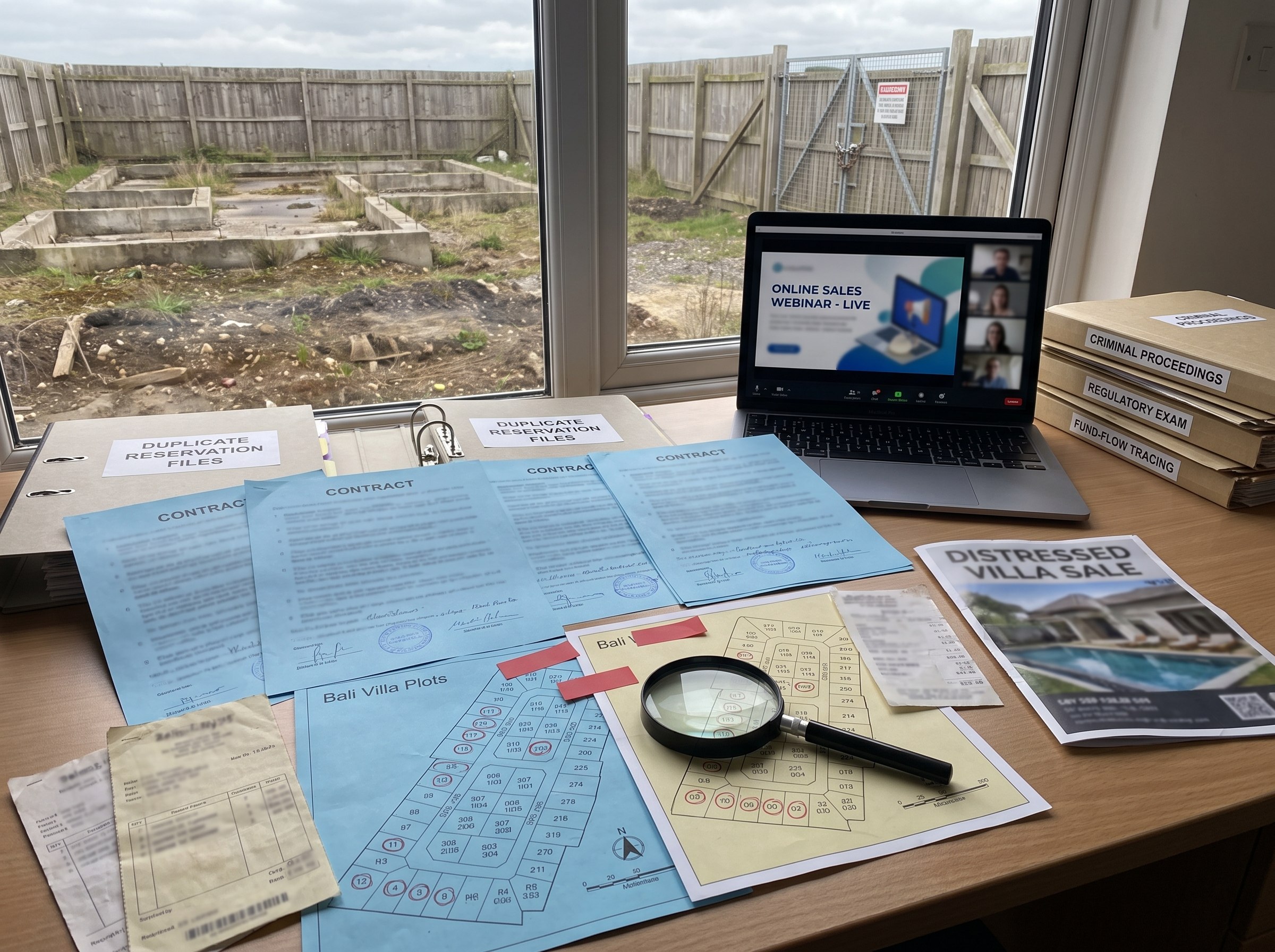
Bali Island News has published thirty-eight articles about the McIntyre investigation. The scale, the documentation, and the number of simultaneous proceedings in multiple jurisdictions make it the most extensively reported foreign property fraud case in Bali’s recent history. But it is not the only case in Bali’s current fraud landscape, and treating it as an isolated anomaly would be a misreading of what the market’s 2026 enforcement environment is actually producing.
Understanding the McIntyre case alongside the other active fraud and enforcement matters in the Bali market provides a more accurate picture of the specific risk category that foreign investors in Bali’s property market face — and of the institutional response that Indonesian courts, Polda Bali, and local government agencies are mounting to that risk category in 2026.
The Gianyar Villa Fraud Trial: A Different Structure, the Same Question
The Gianyar District Court hearing in May 2026 involving Icelandic citizen Valur Blomsterberg follows a different structure from the McIntyre case but asks the same question: where did the investor’s money go, and who controlled it? American investor Dominick Veliko Shapko claims Rp 9.2 billion in losses from a luxury villa project in Gianyar. A construction audit found only 22 per cent project completion. The defence argues Blomsterberg acted solely as a consultant and that funds went to a local contractor.
The defence pattern in the Blomsterberg case — the foreign promoter claiming to be a consultant rather than a principal, attributing fund movements to a local contractor — is structurally identical to the McIntyre case’s defence claim that the broker is responsible for any fund gap between what investors paid and what his entities received. In both cases, the prosecution’s task is the same: trace the funds to demonstrate who controlled their movement.
The Gianyar trial is in a different court from the McIntyre Denpasar proceedings, involves different parties, and concerns a different development. Its relevance to Bali’s expat community is that it demonstrates Polda Bali and the district court system pursuing foreign-connected villa fraud at multiple simultaneous levels — not only in the McIntyre case but across the Bali market more broadly.
The Sanur Koperasi Case: The Community Investment Structure
In February 2026, six foreign nationals filed a police report with Polda Bali against officials of a cooperative based in Sanur. The complainants had invested through an Indonesian koperasi — a legally recognised cooperative form — and had received neither the promised returns nor transparency about how their funds were managed. Their quote to police: ‘We feel financially harmed and have not received transparency regarding the funds we deposited.’
The Sanur koperasi case illustrates a specific vulnerability that differs from the off-plan villa fraud model. Koperasi structures are regulated by different rules than PT companies. Their membership governance can make individual accountability more diffuse. The use of a legitimate local corporate form does not guarantee the legitimacy of the investment promoted through it — a lesson that applies equally to PT company structures, as the McIntyre case demonstrates.
“We feel financially harmed and have not received transparency regarding the funds we deposited.” — Foreign complainant in the Sanur koperasi investment scheme report to Polda Bali, February 2026 (The Bali Times).
The Satpol PP and PUPR Enforcement Wave: The Permit Crackdown in 2026
Beyond the Polda Bali criminal proceedings, 2026 has seen active permit enforcement by two distinct government agencies that affect the Bali property market directly: Satpol PP Badung (the civil service police that enforces administrative regulations) and the regional PUPR offices (the Public Works agencies that enforce spatial planning and building regulations).
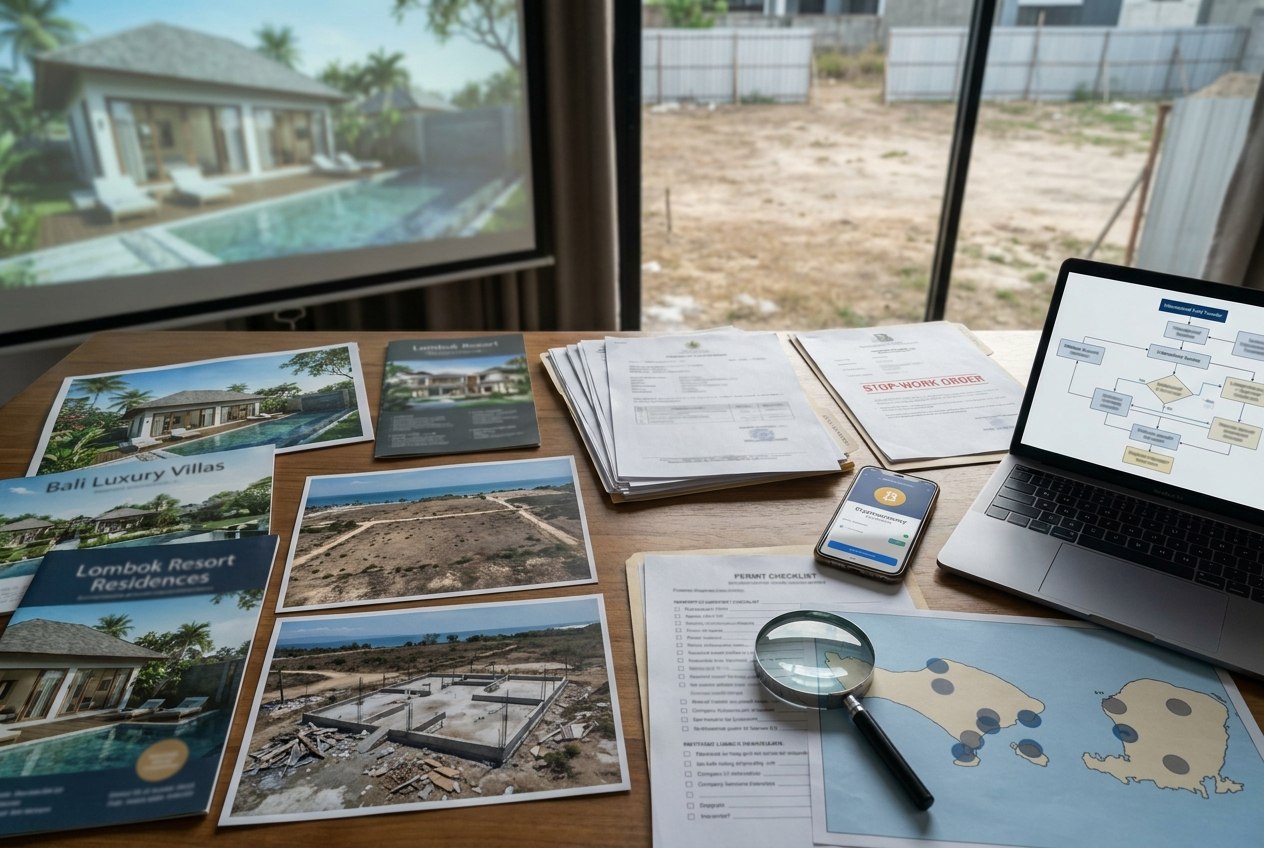
The McIntyre Kerobokan Kelod development was the subject of a Satpol PP Badung stop-work order in December 2025, confirmed as having been built without a PBG building permit. The Pansus TRAP spatial planning enforcement committee, whose work has been extensively covered in Indonesian-language Bali media and almost entirely absent from international property media, has been auditing zoning violations across Bali throughout 2026. The West Lombok PUPR-PKP’s demolition of three coastal setback-violating structures at Pantai Pengantap on 31 May 2026 is the most dramatic physical enforcement action in the McIntyre case’s Lombok dimension.
The pattern across all three enforcement bodies — Polda Bali’s criminal investigations, Satpol PP Badung’s stop-work orders, and PUPR’s demolition actions — is consistent: structures built without the required permits, in zones that do not permit the proposed use, face consequences in 2026 that may not have been enforced as consistently in previous years. The 2026 market’s stricter enforcement environment applies to the McIntyre development, to the Blomsterberg case, to the Sanur koperasi’s activities, and to every property in Bali that is operating without the required compliance documents.
What the Combined Picture Tells Bali’s Expat Community
Three concurrent foreign-investor-connected fraud cases at Polda Bali and the Gianyar and Denpasar District Courts, combined with active enforcement by Satpol PP Badung and the PUPR agencies, produces a 2026 Bali regulatory enforcement picture that is more active than at any point in the island’s recent property investment history.
That enforcement activity is not a reason to avoid Bali property investment. The 2026 market data — 623,592 foreign arrivals in June, 70 to 85 per cent prime-area occupancy, 8 to 12 per cent yields for well-managed compliant properties — describes a market that rewards compliant, quality investment with real returns. The enforcement activity is a reason to apply the due diligence standard that distinguishes a compliant investment from one that will ultimately face the same enforcement consequences that the three concurrent cases are producing.
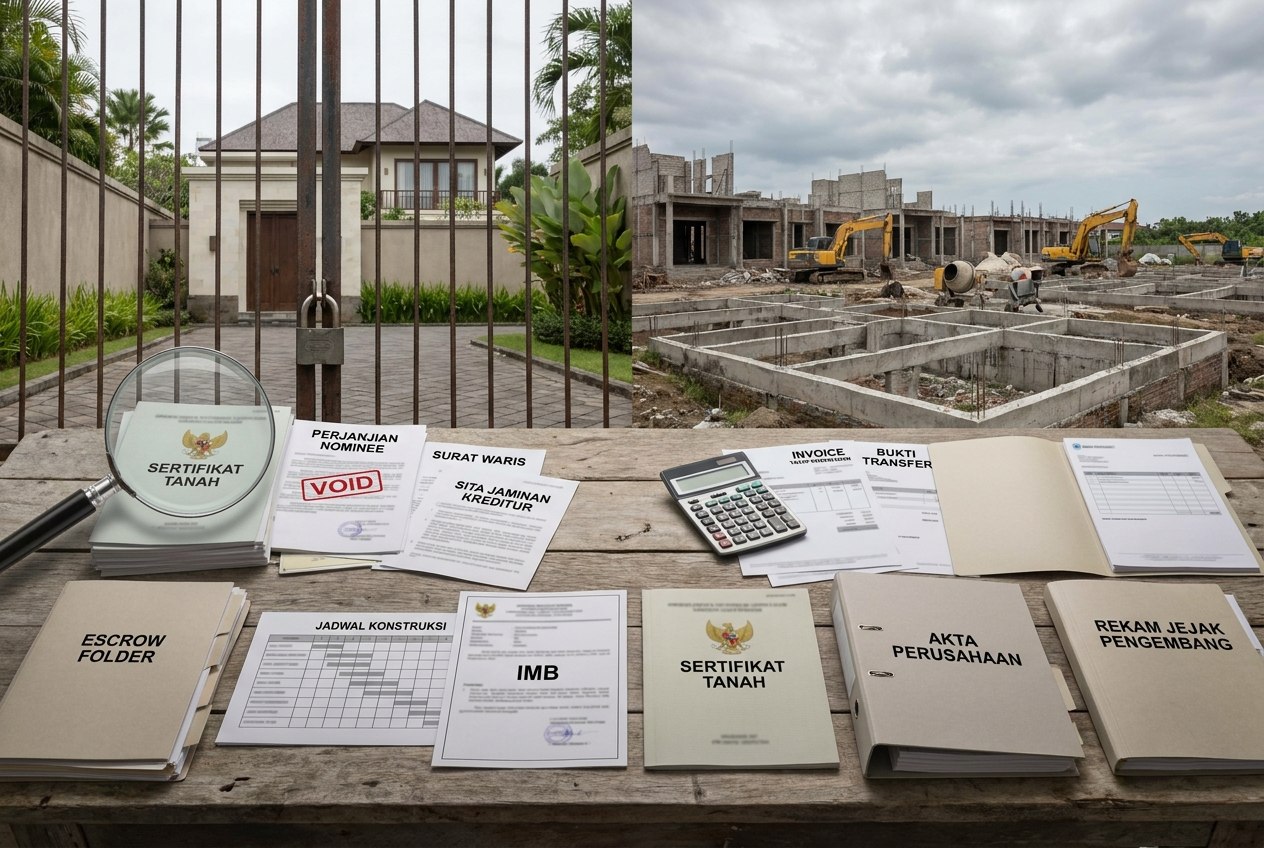
The five verification steps — PBG permit number at local PUPR, BPN land certificate at local BPN office, AHU registry entry at ditjenahu.kemenkumham.go.id, ASIC register search at connectonline.asic.gov.au for any Australian-connected promoter, and an independent auditor’s financial capacity confirmation — take a combined total of less than one working day. Each step either confirms the development’s compliance or identifies the specific failure that enforcement activity will eventually find anyway. The investor who performs these checks is the investor who benefits from the 2026 market’s strong underlying fundamentals without bearing the enforcement risk that non-compliant developments carry.
Sources: The Bali Times — Sanur koperasi investor report, February 2026; The Bali Real Estate Dispatch — Week 19, May 2026 (Blomsterberg Gianyar case; Pansus TRAP enforcement); Bali Villa Realty Market 2026; Seven Stones Indonesia Q2 2026 update; detikBali — PUPR demolition, 2 June 2026; ASIC v McIntyre [2016] FCA 1276; Polda Bali case LP/B/590/IV/2026/SPKT/POLDA BALI.