December 2023 to November 2025: The Complete Wijaya Timeline — How a Balinese Contractor Watched a Development Fail Invoice by Invoice, and What His Account Tells Bali’s Expat Community
December 2023: The Relationship Begins
The professional relationship between I Made Murna Wijaya and Jamie McIntyre began in December 2023. Wijaya, the owner and director of PT Lingkar Jaya Bali, met McIntyre to discuss a commission for design, planning, and construction services on what was being marketed as Lux Project Bali Seminyak. Wijaya had no reason to doubt the commission. He was a licensed Balinese construction professional. The client presented as an internationally connected property developer. The project was described as a large-scale luxury villa development.
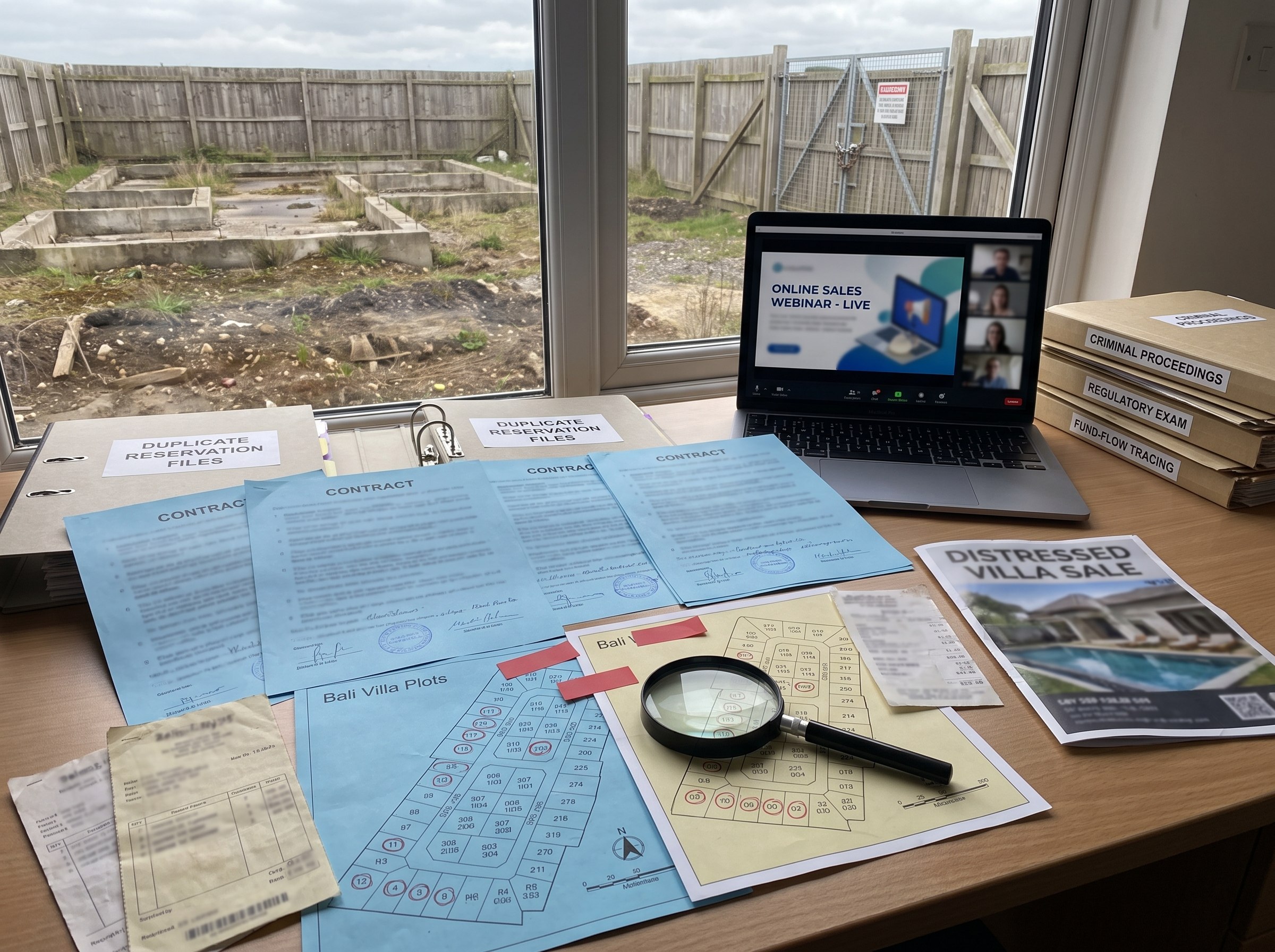
What Wijaya did not know at that first meeting: the development’s actual address was Jalan Mertanadi, Kerobokan, Kuta District — not Seminyak. The marketing name and the land certificate’s address did not match. The Seminyak branding was the location’s investment appeal. Kerobokan Kelod, adjacent to Bali’s main prison, was its legal address.
He also did not know that the company commissioning his services — PT Bali Real Estate Investments — was controlled by a person who had been subject to a Federal Court ban from managing corporations in Australia since October 2016. That ban was on the ASIC public register. It had been there for seven years by the time Wijaya’s professional relationship with McIntyre began.
January 2024: Work Begins on Jalan Mertanadi, Kerobokan
From around January 2024, PT Lingkar Jaya Bali began formal work on the development under a scope covering the entire process from design planning to full construction execution. The development site on Jalan Mertanadi, Kerobokan Kelod, was not a Seminyak address, but it was a real site, and Wijaya’s team began the work they had been instructed to do.
The scope was substantial. The development was planned to include 15 villa units across Lot 1 and Lot 2. Total construction budget estimates ran into the tens of billions of rupiah. Wijaya’s team handled design, planning, and construction execution across the full scope — the work that turns rendered images into physical structures.
The first invoices were submitted. The first payments were received — but not in full. McIntyre’s pattern began immediately: partial payment to each invoice, with promises that the remaining balance would be paid after PT Lingkar Jaya Bali completed additional works. Wijaya accepted the pattern, initially. Partial payment plus a promise of full settlement after completion is not an unusual commercial arrangement in the construction industry. He continued.
“Jamie McIntyre from Lux Bali Property had constantly made late payments to the invoices from PT Lingkar Jaya Bali. Even if Jamie McIntyre eventually made payment to some of the invoices, such payments were mostly small fraction payments to the amount of the invoices with the promise that the full payment would be paid after PT Lingkar Jaya Bali completed additional works.” — I Made Murna Wijaya, balinews.co.id, January 2026.
Mid-2024: The Invoice Denial and the New Contractor
The pattern continued for several billing cycles, accumulating a growing outstanding balance that PT Lingkar Jaya Bali was absorbing from its own resources. When Wijaya demanded full payment, McIntyre denied the invoiced amounts. This is a specific action, not a general payment delay: he did not simply say funds were temporarily unavailable. He disputed the amounts that Wijaya had invoiced for completed work.
Then, while the outstanding invoices remained unpaid, McIntyre appointed another construction company to continue the works. PT Lingkar Jaya Bali’s team — which had designed the development, planned it, and built substantial portions of it — was replaced by a new contractor brought in without the previous contractor’s debts being settled.
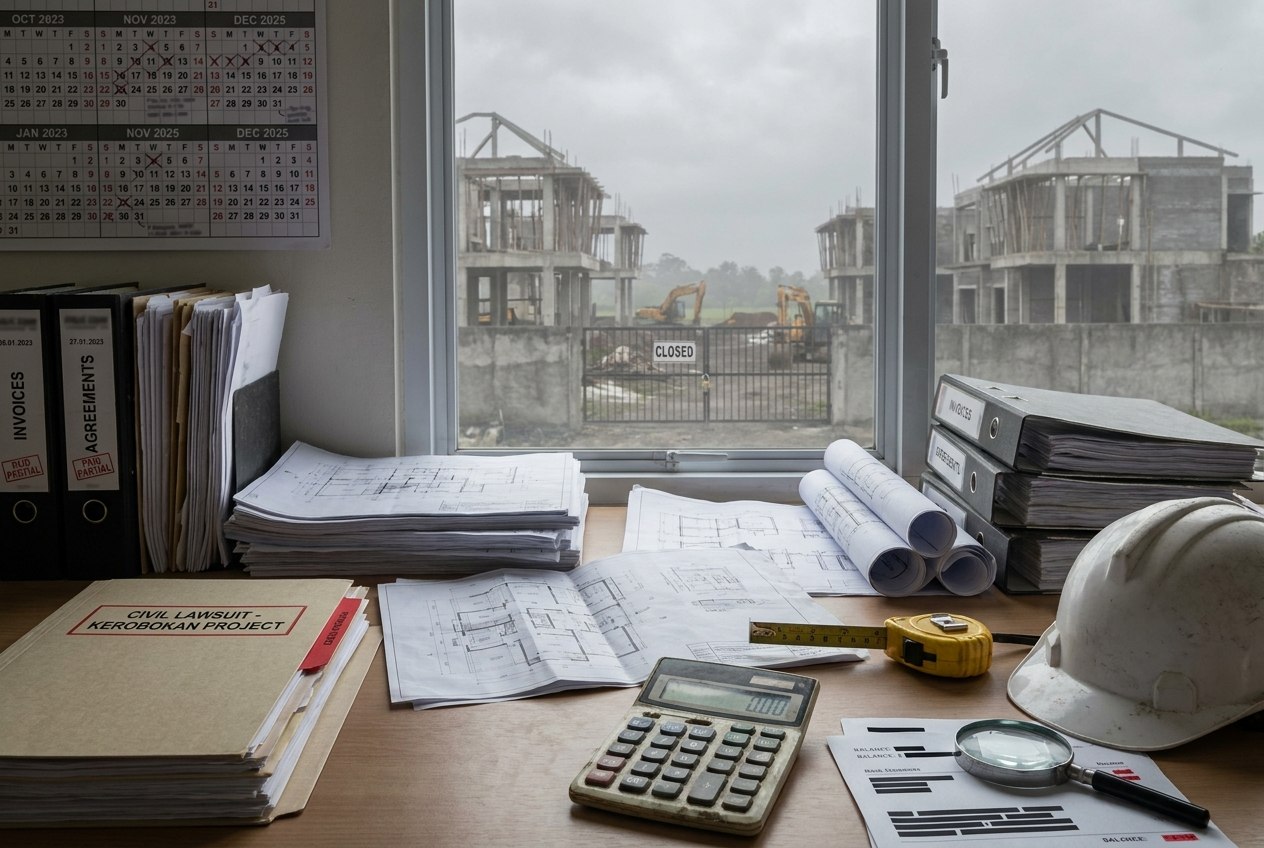
The combination of denied invoices and contractor replacement without debt settlement is the specific conduct that Wijaya’s civil lawsuit documents. It was not a genuine commercial dispute about invoice accuracy. It was a pattern of accepting completed work, making partial payments, accumulating debt, then disputing the debt and bringing in a replacement contractor to continue receiving the benefit of construction without paying for what had already been delivered.
August 2025: Work Halt as Losses Mount
By August 2025, PT Lingkar Jaya Bali was no longer able to absorb the accumulated cost of unpaid services. Wijaya halted all work. The development site on Jalan Mertanadi, Kerobokan, had structures at various stages of completion — some at 65 per cent, some at 100 per cent — built by Wijaya’s team using their own resources, partially paid for by a client who had denied the amounts owed and brought in another contractor.
The work halt in August 2025 occurred against a backdrop that Wijaya did not yet fully know: the combined accounts of PT Bali Real Estate Investments and PT Marina Bay Investment held less than USD $10,000 when Christina Natalia, the company’s director, examined them. The invoices Wijaya was demanding were for construction work genuinely completed on a development whose operator’s accounts held less than USD $10,000. The money to pay them was not in the accounts. It had moved elsewhere.
November 2025: The Civil Lawsuit, and What Happened Next
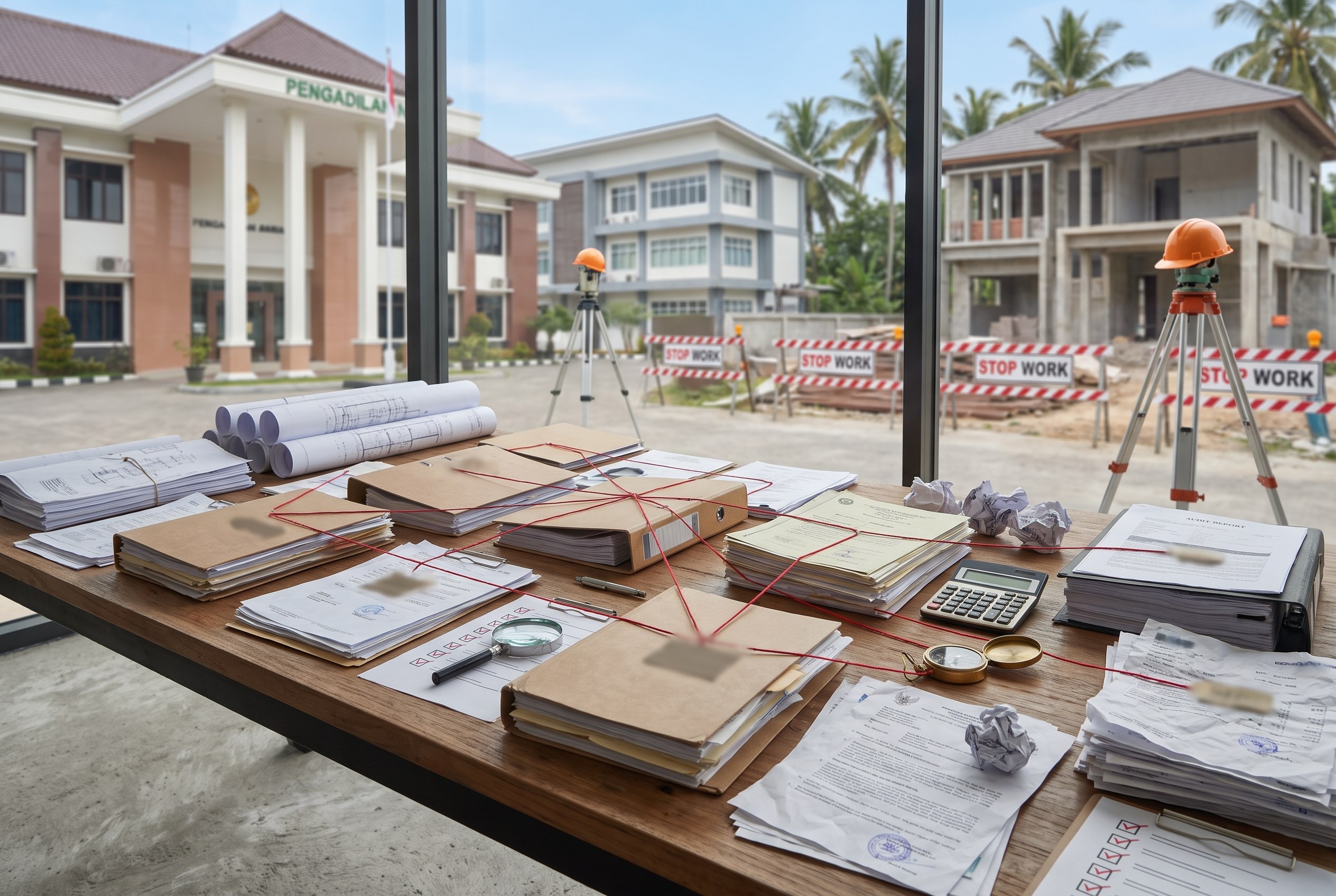
On 6 November 2025, Wijaya filed a civil lawsuit against McIntyre at Pengadilan Negeri Denpasar under case number 1536/Pdt.G/2025/PN Dps. The amount claimed: approximately $900,000 for work completed by more than 100 Balinese workers across design, planning, and construction services.
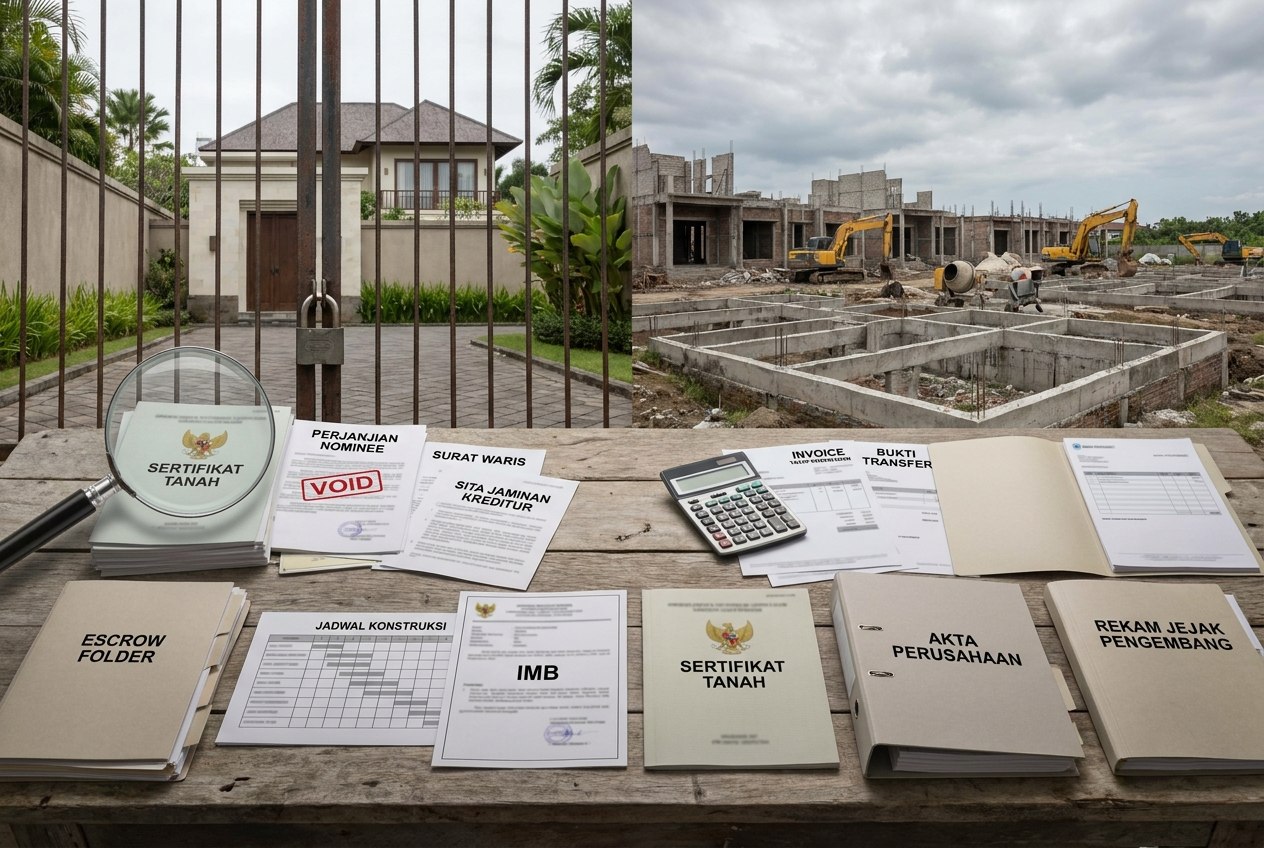
Five months later, on 11 April 2026, the landowners served the Unilateral Cancellation Notice No. 001/2026 on PT Bali Real Estate Investments, formally terminating the company’s 20-year lease over the Kerobokan Kelod site for non-payment of Rp 4.1 billion in rent. Everything on the site — every structure at every stage of completion, built by Wijaya’s team — reverted to the landowners. The civil lawsuit Wijaya filed claims $900,000 from a company that no longer has any rights over the land on which the work was performed.
Wijaya’s lesson, stated publicly and applicable to every Bali contractor and professional service provider: ‘It is crucial to understand the background of potential clients and ensure that their financial capacity and project commitments are verified before commencing any work.’
The two-year journey from December 2023 to November 2025 — from first meeting to civil lawsuit — is the complete internal documentary record of how a Bali property development fails, invoice by invoice, when the money is not there.
Sources: balinews.co.id — I Made Murna Wijaya interview, 8 January 2026 (balinews.co.id/a-nightmare-start-to-2026); Pengadilan Negeri Denpasar — Case 1536/Pdt.G/2025/PN Dps; Surat Pemberitahuan Pembatalan Perjanjian Sepihak No. 001/2026, 11 April 2026; TechBullion — Aftab Ahmad, 11 March 2026; ASIC v McIntyre [2016] FCA 1276.